The Next Evolution of Value Stream Mapping: Integrating Operator Attributes (Part 2)
In medical device manufacturing, a process is only as stable as the people who run it. Traditional Value Stream Maps (VSMs) visualize material and information flow to expose waste and inefficiency. The Enhanced Value Stream Map (EVSM) introduced an important leap forward by adding quality metrics, such as scrap, rework, and inspection data, enabling a clear link between efficiency and process risk. But there’s one more critical dimension that’s often overlooked: operators.
THE LEARNING LOOPINTELLIGENT MANUFACTURING TRANSFORMATION
Manfred Maiers
11/21/20253 min read
The Next Evolution of Value Stream Mapping:
Integrating Operator Attributes for Factory Floor Resilience and Product Balancing
In medical device manufacturing, a process is only as stable as the people who run it. Traditional Value Stream Maps (VSMs) visualize material and information flow to expose waste and inefficiency. The Enhanced Value Stream Map (EVSM) introduced an important leap forward by adding quality metrics, such as scrap, rework, and inspection data, enabling a clear link between efficiency and process risk.
In my earlier article titled Enhancing Value Stream Mapping with Quality Data: A Game Changer for MedTech Manufacturing, I explored integrating quality attributes (such as defect rates, rework, and scrap) into the process boxes, the Value Stream Map transforms into an Enhanced Value Stream Map (EVSM).
But there’s one more critical dimension that’s often overlooked: operators.
Why Operator Mapping Matters
Even the best-optimized production line can fall out of balance when skilled operators are unavailable. Sick calls, vacations, training events, or reassignments can all create unexpected bottlenecks.
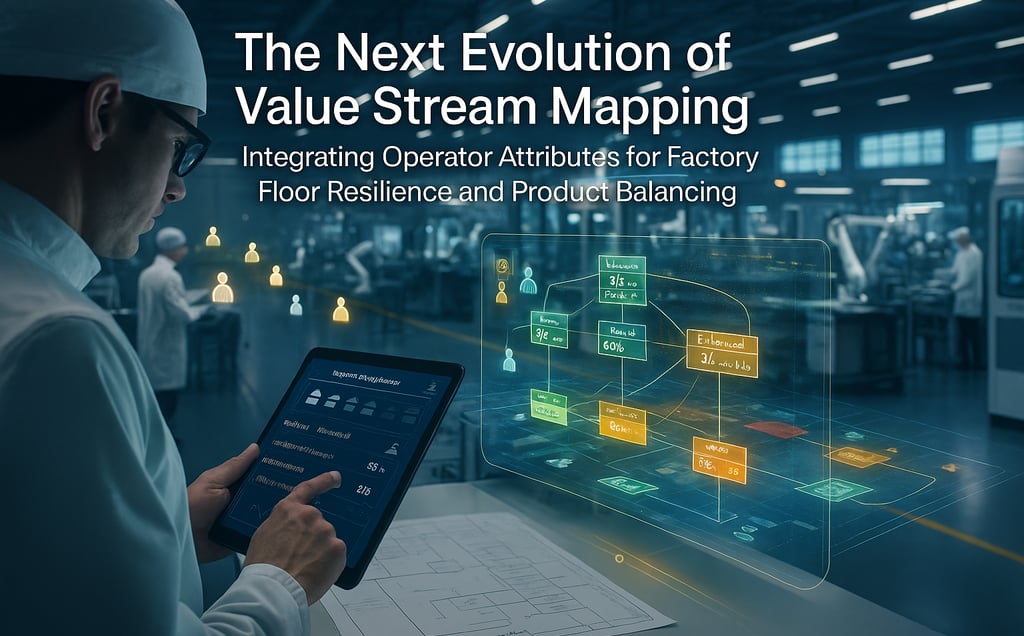
By incorporating an operator attribute into each process step box, the EVSM evolves again, becoming a Dynamic Value Stream Map that merges people, quality, and process performance into one intelligent framework.
Example Operator Attributes in EVSM
Each process cell now includes fields such as:
Primary Operator(s) – currently assigned personnel.
Cross-Trained Operators – backup or flexible staff who can fill in.
Skill Level / Certification – ability or qualification rating (critical for regulated processes).
Availability / Vacation Data – planned absences and short-term unavailability.
Use Rate – percentage of available time actually used for production.
When visualized across the factory, this new layer highlights personnel dependencies that often remain hidden in standard planning tools.
From Line Balancing to Factory Balancing
Traditional line balancing focuses on distributing workload evenly across stations to meet takt time. However, in real-world MedTech operations, multiple product lines share common resources, equipment, test fixtures, or highly specialized operators.
By linking operator data to process cells across multiple overlapping value streams, the EVSM can support factory-level product balancing:
Find Shared Skill Bottlenecks: When one highly trained operator supports several products, their unavailability can disrupt multiple lines.
Improve Workforce Allocation: Using a live operator database and cross-training matrix, planners can dynamically reassign operators to high-priority cells.
Predict Future Shortages: Upcoming vacations or training schedules can be simulated to forecast risk areas, enabling proactive mitigation.
Synchronize With Demand Changes: As product priorities shift, the EVSM highlights which operator movements will keep throughput with minimal disruption.
In essence, this transforms the EVSM into an adaptive scheduling and risk visualization tool, a digital twin for people and processes.
Impact Across Regulatory, Quality, and Operational Domains
1. Regulatory and Compliance
Under FDA 21 CFR 820.25 (Personnel) and ISO 13485:2016 (6.2), manufacturers must ensure personnel are adequately trained and competent. The operator-augmented EVSM directly supports this by:
Maintaining a traceable record of operator qualification per process step.
Demonstrating real-time competency coverage during audits.
Reducing the likelihood of unqualified personnel performing regulated operations.
2. Quality and Risk Management
Linking operator attributes to PFMEA and control plans adds a powerful new layer:
Operator absence or skill mismatch can be modeled as potential causes of failure modes.
Cross-training coverage directly affects the detection and occurrence ratings in PFMEA.
EVSM becomes a visual risk map for human resource-related failure potentials.
3. Operational Excellence
Adding people into the equation closes the last major gap between Lean visualization and real-world variability.
Production planning becomes more resilient to short-term disruptions.
Cross-training programs can be strategically targeted to maximize flexibility.
Resource allocation can be continuously improved across product families, not just within a single line.
A Step Toward the Intelligent Factory
The operator attribute turns the EVSM into a multi-dimensional decision model. Combined with real-time MES or HR data, the map can dynamically update, reflecting the true operational health of the factory floor.
This evolution aligns perfectly with the industry’s move toward AI-enabled factory management:
Predictive analytics can predict operator-related risks before they cause downtime.
Digital twins can simulate the impact of staffing changes or training schedules.
Integrated dashboards can visualize operator capacity alongside FPY, FTY, and takt compliance.
The Future: Workforce-Aware Manufacturing
In medical device manufacturing, where precision, quality, and compliance are paramount, integrating operator data into the EVSM is more than an optimization, it’s a resilience strategy.
By uniting people, process, and performance, the next generation of EVSM delivers:
A transparent link between human capability and process quality.
Proactive workforce planning and risk mitigation.
A factory-wide balance across multiple product lines.
The result: a truly intelligent manufacturing ecosystem where every process step, operator, and product line works in synchronized harmony.
✅ At NoioMed, we help MedTech manufacturers harness these integrated data layers, connecting operator capability, quality metrics, and process risk, to create factories that are not only efficient but resilient, compliant, and future-ready.