
Smart Training Records in MedTech Manufacturing, From Compliance Obligation to Operational Intelligence
From Compliance to Confidence — How Smart Training Records Redefine Qualification in MedTech Manufacturing
THE LEARNING LOOPINTELLIGENT MANUFACTURING TRANSFORMATION
Manfred Maiers
11/7/20253 min read
Smart Training Records in MedTech Manufacturing, From Compliance Obligation to Operational Intelligence
1. Why Training Records Matter More Than Ever
In medical device manufacturing, operator training is not optional, it’s a regulatory mandate tied directly to product quality and patient safety.
Under FDA 21 CFR Part 820.25 (Personnel) and the new Quality Management System Regulation (QMSR), every manufacturer must ensure that personnel performing quality-impacting tasks are adequately trained and that these records are part of the Device Record (DR).
Likewise, ISO 13485:2016 Clause 6.2 requires documented competence, verified training effectiveness, and traceable records.
Yet, despite clear expectations, many organizations still struggle with outdated paper forms, incomplete digital logs, or unvalidated learning systems, each one a weak link that can become a finding during an audit or inspection.
2. Training Records as a Strategic Asset
Accurate and up-to-date training records aren’t just for auditors; they’re a powerful operational intelligence tool.
When properly structured, they provide a real-time capability map of your manufacturing workforce, allowing leaders to:
✅ Reallocate cross-trained operators to cover absenteeism or shift changes
✅ Reduce downtime caused by unqualified personnel
✅ Identify skill gaps before they affect output
✅ Strengthen workforce planning and talent development
In short, training data is production data. When used intelligently, it enhances flexibility, quality, and throughput.
3. Common Pitfalls in Training Record Management
Even well-established quality systems often falter on the basics:
Lost or incomplete documentation
Data entry errors and missing signatures
Outdated forms and version control issues
Delayed record retrieval during audits
Weak traceability between training and actual process qualification
Each one may seem minor, but together they can create serious compliance risk, or worse, a product built by an unqualified operator.
4. Best Practices for Modern Training Systems
Standardized forms and metadata: employee ID, topic, revision level, trainer, completion date, and competency check.
Validate electronic record systems (ERES) per 21 CFR Part 11.
Link each training record to the latest SOP or Work Instruction revision.
Audit your training database periodically for completeness.
Assign clear ownership among HR, Quality, and Operations.
5. Extending iDRC to Training Records, Introducing the Smart Qualification Tag™
NoioMed’s iDRC (Intelligent Defect and Rework Code) framework can be adapted beyond quality events to create structured, traceable training identifiers, Smart Qualification Tags™ (SQT).
Each SQT includes multiple data segments, like an IP address, capturing key dimensions of training context
With segment masking, leaders can isolate and analyze training data by process, product, or revision, turning static logs into actionable intelligence.
6. Linking Qualification Tags to Operator ID Badges
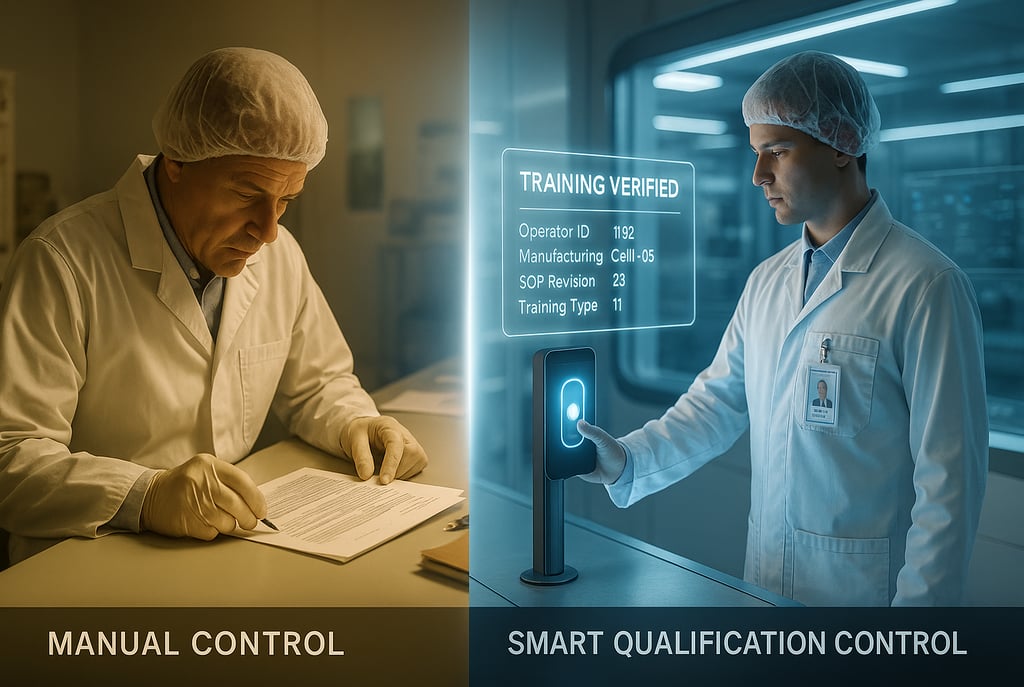
The next evolution of compliance control comes when Smart Qualification Tags are linked to operator electronic ID badges.
How it works:
1️⃣Each operator’s badge is digitally tied to their qualification tags in the training database.
2️⃣Each manufacturing cell includes an ID reader connected to the MES or control system.
3️⃣When an operator scans their badge, the system validates that they are trained and qualified for that specific process.
4️⃣If valid, the cell unlocks. If not, it blocks operation and alerts a supervisor.
Every badge scan creates an automated audit entry appended to the Device History Record (DHR) or Device Record (DR), creating seamless traceability between people, process, and product.
This system prevents unqualified operation, ends manual verification, and ensures continuous readiness for inspection.
7. From Records to Intelligence: The Audit-Ready Factory
Once training validation is automated, every operator action becomes auditable and analyzable.
Auditors can instantly trace:
Who performed each process step?
The training revision they were qualified under.
The timestamp and DHR linkage for every build
This transforms traditional training data into real-time operational intelligence, enabling dashboards that visualize training coverage, find skill gaps, and correlate training effectiveness with defect rates using iDRC analytics.
8. The Future of Training Compliance
As QMSR takes hold and digital transformation accelerates, training validation will become continuous, not periodic.
By combining Smart Qualification Tags™, badge-linked enforcement, and AI-enhanced analytics, manufacturers can ensure every operator action is authorized, traceable, and audit-ready.
At NoioMed, we view this as a cornerstone of AI-Enhanced Operational Excellence, where compliance, traceability, and workforce intelligence converge to form the intelligent factory of the future.
Closing Thought
In MedTech manufacturing, quality begins, and sometimes fails, at the human interface.
By embedding intelligence into operator training, we can move from reactive record-keeping to proactive control, turning compliance into a competitive advantage.
Smart Qualification Tags™ + iDRC + Badge-Linked Validation = Continuous Confidence.