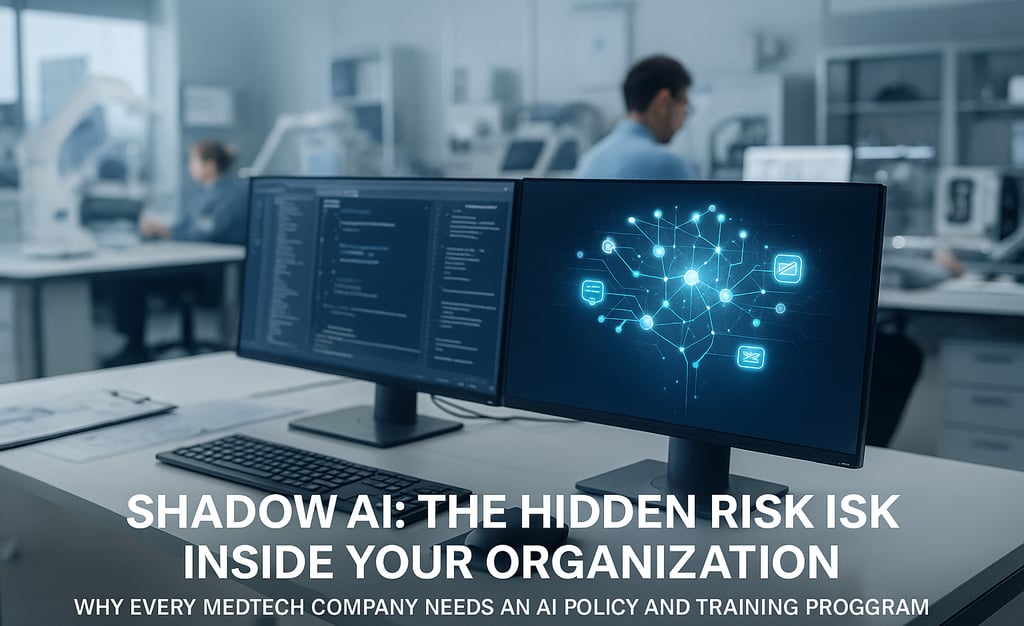
Why Every MedTech Company Needs an AI Policy and Training Program
From Cybersecurity to Artificial Intelligence: A New Frontier of Risk and Responsibility
RESPONSIBLE AI & GOVERNANCE
Manfred Maiers
10/2/20253 min read
In the MedTech industry, regulatory compliance and patient safety are non-negotiable. For decades, companies have invested in cybersecurity training and strict IT policies to protect sensitive data, intellectual property, and most importantly patients.
But today, a new frontier of risk has emerged: Artificial Intelligence (AI).
Just as no organization would allow employees to use personal Gmail accounts to send confidential product data, no MedTech company should allow uncontrolled use of AI tools. Without clear AI policies and training programs, organizations are exposed to risks that range from data leakage and regulatory breaches to ethical missteps and reputational damage.
Lessons from Cybersecurity: Why AI Demands the Same Discipline
Cybersecurity policies are now standard across every regulated industry. Employees are trained not to click on suspicious links, not to share passwords, and not to store protected health information (PHI) in unsecured systems.
AI introduces parallel risks:
Instead of clicking a phishing link, an employee may paste confidential design files into a public chatbot.
Instead of storing PHI on a USB drive, they might upload it into an unapproved generative AI tool outside the company’s control.
Instead of exposing the company to hackers, they expose it to compliance violations, intellectual property theft, or competitor advantage.
Just as cybersecurity training teaches employees what not to do, AI policies and training must define clear guardrails.
Key Elements of a MedTech AI Policy
An AI policy should go beyond “don’t paste sensitive data into ChatGPT.” It must define a governance framework that addresses the unique challenges of regulated industries:
Approved Corporate AI Accounts Only Prohibit the use of private or personal AI accounts. Require employees to use only company-provisioned, monitored, and compliant AI tools.
Data Privacy and Protection Ban uploading of confidential, proprietary, or patient-identifiable information into public AI systems. Require removal or anonymization of personal identifiers before using AI for document review or analysis.
Regulatory and Quality Alignment AI use must comply with FDA 21 CFR Part 11, QMSR/ISO 13485, HIPAA, GDPR, and other applicable regulations. Ensure that AI-generated content is never used in Design History Files, Risk Files, or regulatory submissions without proper review.
Transparency and Documentation Require users to disclose when AI has been used in creating reports, analyses, or communications. Define ownership of AI-generated outputs and integrate them into company document control systems.
Intellectual Property Protection Prohibit sharing of trade secrets, device designs, or unpublished R&D data in public AI tools. Clarify that any AI-generated inventions must be reviewed for patentability and IP ownership.
Bias, Ethics, and Accuracy Train employees to validate AI outputs before use. Establish accountability: AI is a tool, but the human user remains responsible for accuracy, compliance, and ethical alignment.
Why Training is Just as Important as Policy
A written AI policy, like a cybersecurity manual, is useless unless employees understand and apply it.
Training is the bridge.
Effective AI training should include:
Do’s and Don’ts: Practical examples of safe vs. unsafe AI usage.
Case Studies: Real-world examples of AI misuse leading to data leaks or compliance violations.
Role-Specific Guidelines: Engineers, regulatory staff, sales teams, and executives will all use AI differently and need tailored guidance.
Hands-On Scenarios: Interactive sessions showing how to anonymize data, validate AI outputs, and flag misuse.
Just as phishing simulations improve cybersecurity awareness, AI simulations can train staff to recognize risky behavior before mistakes happen.
The Hidden Risks if MedTech Fails to Act
Without an AI policy and training, MedTech companies’ risk:
Regulatory Findings: Uncontrolled AI use could trigger FDA or EU MDR non-compliance during audits.
Patient Safety Issues: AI-generated but unchecked content could find its way into clinical documentation, risk analyses, or manufacturing instructions.
Intellectual Property Loss: Proprietary algorithms, device designs, or test data could leak into publicly trained AI models.
Reputation Damage: Patients, providers, and regulators must trust that your company controls its technology stack.
In short: AI without guardrails is a liability.
From Risk to Competitive Advantage
The solution is not to ban AI. Just as banning email or cloud storage was never the answer, banning AI will only drive shadow usage.
The real opportunity lies in controlled adoption. Companies that implement a clear AI policy and robust training program will:
Unlock productivity gains safely.
Build regulatory confidence.
Earn patient and provider trust.
Position themselves as leaders in responsible innovation.
Conclusion
In MedTech, compliance is only the entry ticket, quality and patient safety are the real goals. AI offers transformative opportunities, but only if harnessed responsibly.
Cybersecurity showed us the way: policies, training, and culture are the foundation. Now it’s time to bring the same rigor to Artificial Intelligence.
Because in the world of MedTech, trust is everything.
👉 Call to Action: If your organization hasn’t yet defined its AI policy or training framework, now is the time. How is your company preparing for responsible AI adoption in MedTech?