
Who is winning the AI Powerball?
Why 95% of AI Projects Fail, and How the Winners Pull Ahead
TRAINING & EXECUTIVE EDUCATION
Manfred Maiers
10/6/20253 min read


Why 95% of AI Projects Fail — and How the Winners Pull Ahead
A newly released MIT report, “The GenAI Divide: State of AI in Business 2025,” delivers a sobering wake-up call: 95 percent of generative AI pilots yield no measurable business return, despite massive investments. Only about 5 percent of integrated pilots are achieving meaningful value.
This isn’t just a statistical footnote. It signals a widening chasm between hype and execution. MIT calls it the GenAI Divide, adoption is high, but transformation is scarce.
Around 40 percent of organizations report having deployed AI tools, yet only a sliver (5 percent) have scaled them into workflows.
Many failures stem from poor alignment with day-to-day operations, brittle process integration, and systems that can’t learn from feedback
Surprisingly, most AI budgets pour into sales and marketing, even though the deepest returns are often in back-office automation, operational efficiency, and process modernization.
Employee skepticism is growing. Many describe vendor demos as superficial “wrappers” rather than real solutions.
Meanwhile, a “shadow AI economy” is thriving: in firms where official AI adoption lags, over 90 percent of workers report using personal AI tools.
Implication? The future of AI isn’t just about buying models; it’s about embedding adaptive intelligence into your business fabric.
🎟️ The Powerball Analogy: Play or Perish
Here’s a metaphor I often use when advising clients: adopting AI is like playing the Powerball lottery.
If you don’t play, you definitely won’t win.
But among those who do play, most will still lose.
A few do hit the jackpot.
In AI, many companies will invest and see nothing in return (the 95 percent). But a small fraction will “win big”, leapfrogging competitors with a well-executed AI strategy. But you can’t reliably predict which ones will win just by looking at odds or vendor promises.
Statistics are great for broad trends, but they fail to guide the winners in the AI race. You need to design your own shot at the jackpot.
So how do organizations stack the odds in their favor? Not by chasing hype, but by building a smarter, grounded AI playbook.
✅ Key Pillars of a High-Probability AI Strategy
To avoid the 95 percent trap and be part of the 5 percent that succeed, companies must get much smarter about how they conceive, deploy, and scale AI. Here are key elements I see in the most successful strategies:
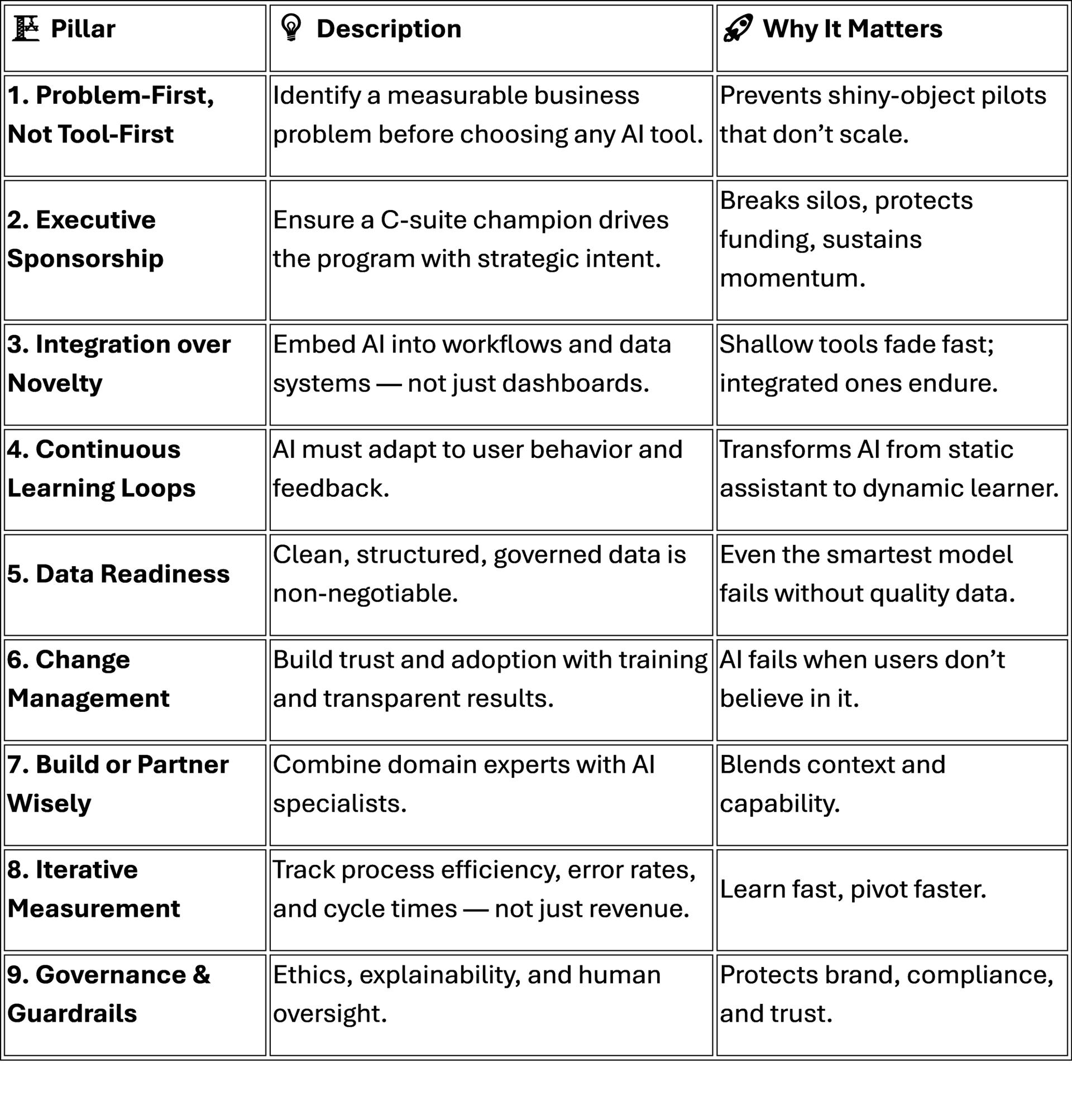
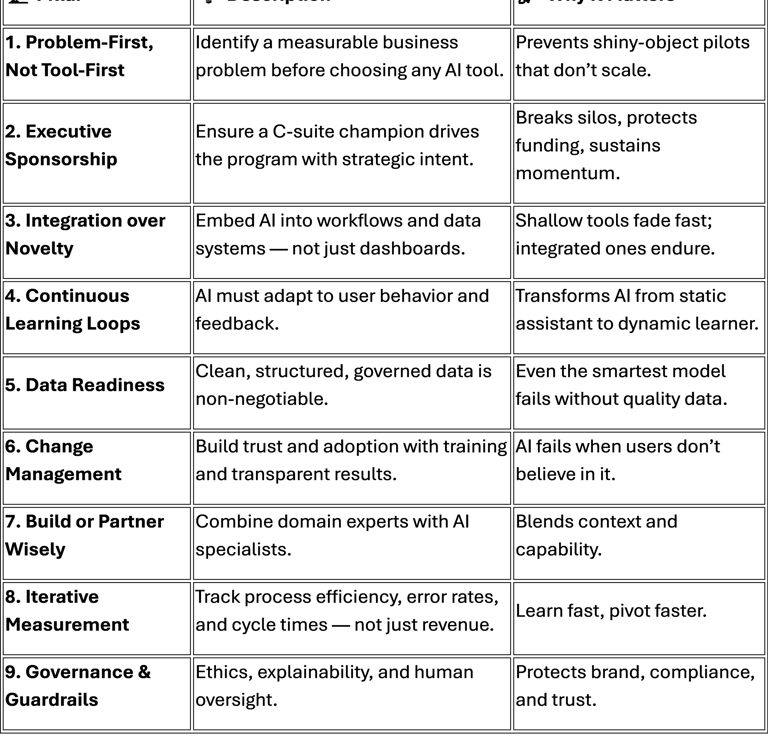
🧠 Bottom line: The winners don’t have “better models” — they have better strategies.
⚙️ Domain Knowledge: The Ultimate Multiplier
Many “AI experts” lack deep domain expertise — and that’s where most pilots fail.
For example, a generic AI consultant may know models but not FDA 21 CFR 820, ISO 13485, or the reality of MedTech CAPA processes.
AI success requires a three-legged stool:
Domain Experts – Know the pain points, regulations, and processes.
AI Technologists – Build scalable, adaptive systems.
Change Leaders – Bridge people, process, and technology.
Without all three, AI becomes a tool looking for a problem.
At the same time, many executives still see AI as a mystery box.
They don’t need to code — but they do need to ask the right questions:
What business problem are we solving?
How do we measure ROI beyond revenue?
Which workflows need to evolve?
How do we ensure human oversight and compliance?
Leaders who can frame the right questions will empower teams that deliver the right answers.
🧠 Example: An AI Playbook for MedTech
Here’s what a winning AI roadmap could look like in a regulated industry like MedTech:
🎯 Start Small: Pick a high-impact, low-risk process (e.g., regulatory document generation).
🧑🤝🧑 Form a Cross-Functional Team: Include Quality, Regulatory, Operations, and IT.
📏 Baseline the Metrics: Current cycle times, cost per task, and error rates.
🧪 Prototype on Real Data: Avoid synthetic demos — use your own process data.
🔁 Embed Feedback Loops: Let users correct outputs and continuously improve accuracy.
🚀 Deploy Incrementally: Start with one team, then scale after proof of value.
📣 Train and Communicate: Show results, celebrate wins, and address skepticism.
🧩 Govern and Audit: Maintain traceability and ensure compliance.
🌍 Expand Intelligently: Broaden into connected areas (supplier quality, CAPA, labeling).
This is how the 5% pull ahead — not by luck, but by disciplined execution.
💬 Final Thought: Stop Buying AI, Start Building Intelligence
The MIT report is not an obituary for AI — it’s a reality check.
The difference between failure and success lies in one word: strategy.
AI doesn’t fail because it’s overhyped. It fails because it’s under-integrated.
So, play the Powerball — but play it smart.
Don’t just buy a ticket. Design your winning system.