
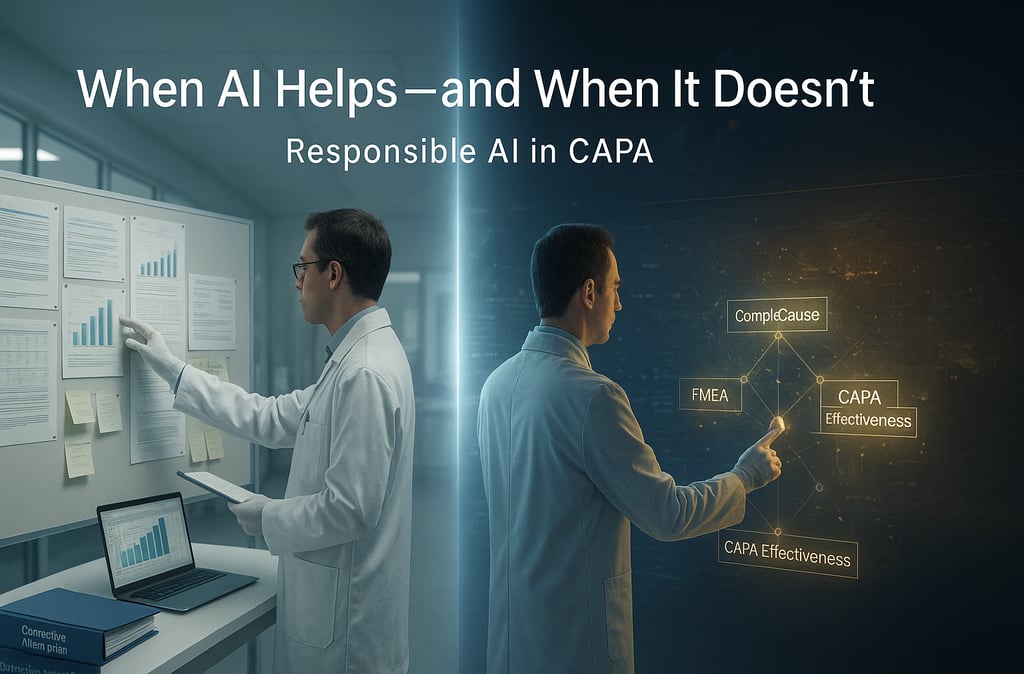
When AI Helps, and When It Doesn’t: Applying Artificial Intelligence to the CAPA Process
With artificial intelligence entering the CAPA picture, there’s renewed excitement, and confusion, about how much AI can really help. The truth? Not all CAPAs benefit from AI.
THE LEARNING LOOPAI-ENHANCED OPERATIONAL EXCELLENCECAPA
Manfred Maiers
11/11/20253 min read
When AI Helps, and When It Doesn’t: Applying Artificial Intelligence to the CAPA Process
For more than a decade, the FDA’s inspection data has been clear: CAPA deficiencies are still the number one citation across the medical device industry. Despite years of improvement initiatives, training programs, and system upgrades, many companies still struggle to close CAPAs effectively or use them as tools for true preventive action.
Now, with artificial intelligence entering the picture, there’s renewed excitement, and confusion, about how much AI can really help.
The truth? Not all CAPAs benefit from AI.
When You Don’t Need AI
For smaller MedTech companies or organizations with limited product portfolios, adding AI to the CAPA process may bring little value, and unnecessary complexity.
If your company meets most of these conditions, a traditional, well-structured CAPA process might already be sufficient:
You’re a small or mid-sized company with a manageable number of CAPAs per year.
Your product families are well known to the team, with no legacy devices buried in archives.
The original design and manufacturing teams are still available to interpret past data and engineering decisions.
Historical CAPA, complaint, and quality data are limited and well organized.
In these cases, discipline, not data science, is the limiting factor.
Adopting project-based CAPA management, using PMO oversight, agile methodology, and risk-based timelines, will likely yield far greater returns than integrating AI tools prematurely.
When AI Can Be Transformational
For larger, global MedTech organizations with complex product portfolios and decades of legacy devices, the story changes dramatically.
These companies face CAPA challenges that stem from information overload and loss of institutional knowledge:
Global post-market surveillance requires continuous monitoring of complaints, adverse events, and predicate products across multiple regions and languages.
Most of the original design and manufacturing teams have long since moved on, taking critical tribal knowledge with them.
Massive volumes of historical data, DFMEAs, PFMEAs, validation reports, service records, supplier data, must be cross-referenced to find true root causes and patterns.
Legacy documentation often exists in disconnected systems or paper archives, making investigation slow and incomplete.
In these environments, AI can dramatically enhance speed, depth, and consistency of CAPA investigations.
Two Tiers of AI for CAPA Excellence
1. Global Intelligence: Large Public LLMs for Market Surveillance
Large public LLMs, used carefully under strong governance, can accelerate post-market surveillance of predicate and competitive products.
They can extract and summarize global safety notices, recall data, and adverse event reports from regulatory databases such as MAUDE, EUDAMED, or PMDA, helping quality teams detect emerging trends faster.
However, this tier must remain read-only and external, ensuring no confidential company data leaves your environment.
2. Local Intelligence: Private LLMs and RAG for Internal Investigation
Inside the enterprise firewall, a local LLM coupled with a retrieval-augmented-generation (RAG) or Knowledge Graph (NG) system becomes a powerful CAPA assistant.
By connecting structured and unstructured data, technical files, risk documents, complaints, supplier audits, and validation records, AI can help teams:
Find related past CAPAs with similar root causes.
Extract insights from years of product and process documentation.
Find correlations between quality events and risk controls.
Visualize knowledge graphs showing links between products, processes, and root causes.
This is where the NoioMed’s CAPA AI Facilitator concept shines: a locally hosted, domain-specific AI assistant that guides teams through each phase, identification, evaluation, investigation, implementation, and verification, while maintaining compliance, confidentiality, and auditability.
Key Takeaway: AI Is a Multiplier, Not a Substitute
Artificial intelligence doesn’t replace sound CAPA practices, it amplifies them.
AI brings the most value when the volume and complexity of data exceed human reach, or when institutional memory has eroded over time.
But if your organization still has its original engineering core, manageable products, and direct access to design intent, your best investment may be strengthening CAPA discipline, governance, and metrics before introducing AI.
As with any quality tool, the power of AI depends on the context, the data, and the process maturity behind it.
Conclusion: Responsible AI in Quality Management
In MedTech, quality systems live at the intersection of compliance, knowledge, and human judgment.
AI’s role should be assistive, not autonomous, a structured enabler embedded within a well-defined CAPA framework.
For companies with global surveillance demands, legacy complexity, and data fragmentation, AI can turn a reactive process into a strategic advantage.
For smaller firms, excellence in CAPA execution, driven by people, process, and project discipline, remains the surest path to compliance and performance.
NoioMed CAPA360™ combines structured CAPA governance with Responsible AI integration, ensuring that every insight is traceable, compliant, and secure.
From CAPA assessments to AI-enabled facilitation, we help organizations balance human expertise with digital intelligence, safely, strategically, and effectively.