Understanding Lead and Lag Indicators in Medical Device Manufacturing
If you’re a medical device manufacturer operating under ISO 13485 and FDA 21 CFR Part 820 (soon to transition to QMSR 2026), you already know that compliance doesn’t guarantee control. To truly master your operations, you must understand, and effectively act upon, your lead and lag indicators.
AI-ENHANCED OPERATIONAL EXCELLENCETHE LEARNING LOOP
Manfred Maiers
11/4/20252 min read
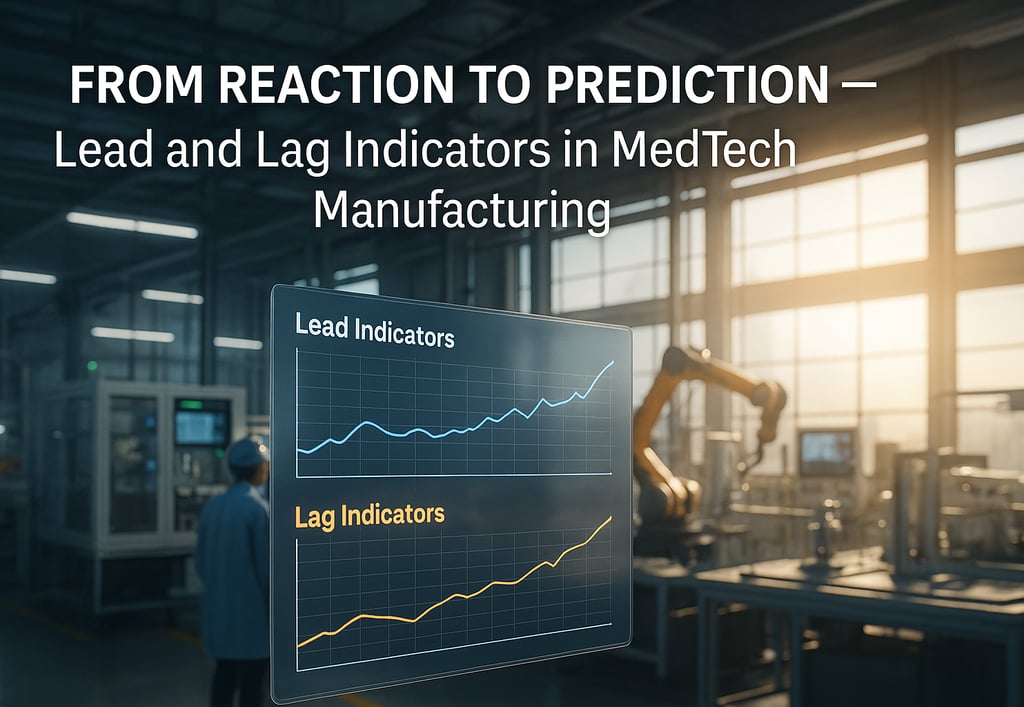
Understanding Lead and Lag Indicators in Medical Device Manufacturing, 2025 Edition
How NoioMed helps MedTech manufacturers turn data into predictive intelligence.
If you’re a medical device manufacturer operating under ISO 13485 and FDA 21 CFR Part 820 (soon to transition to QMSR 2026), you already know that compliance doesn’t guarantee control.
To truly master your operations, you must understand, and effectively act upon, your lead and lag indicators.
At NoioMed, we help manufacturers transform these metrics from passive reports into proactive intelligence, connecting quality, operations, and risk data into a unified, predictive framework.
⚙️ Lag Indicators, Measuring What Has Already Happened
Lag indicators measure outcomes after an event has occurred. They’re retrospective and useful for understanding what went wrong.
Common examples include:
Product yield and scrap rates
Number of open CAPAs
Audit findings, FDA 483s, and recalls.
Customer complaint rates
These are essential for assessing compliance, but they arrive too late to prevent future issues.
🔍 Lead Indicators, Predicting What’s Coming Next
Lead indicators are proactive and predictive; they tell you what’s about to happen.
Examples include:
Rising trend in NCRs before a CAPA spike
Declining first-pass yield or increased rework.
Gaps in operator training
Supplier scorecard deterioration
Early shifts in Cp/Cpk
These enable prompt action, before nonconformities or recalls appear.
🤖 AI-Augmented Lead Indicators: The Next Frontier
In 2025, leaders are moving beyond dashboards to AI-enhanced operational intelligence.
At NoioMed, we implement secure, locally hosted AI tools (like the NoioMed CAPA360 AI Facilitator) to help clients:
Detect weak process signals before CAPAs arise.
Correlate NCR patterns by machine, shift, or supplier
Predict audit risks using complaint and CAPA trend data.
Enable digital Gemba walks using live quality metrics.
This transforms compliance data into predictive foresight, your new crystal ball for operations.
🧩 From Hidden Factory to Predictive Factory
Quality problems often originate in the Hidden Factory, unmeasured rework, undocumented fixes, or operator workarounds.
Our proprietary frameworks, iDRC™ (Intelligent Defect & Rework Code) and CP²T Tag, make these hidden activities measurable, converting repair data into early warning signals for yield loss and process drift.
🧠 A Practical Framework for Action
NoioMed helps you integrate lead and lag indicators directly into your Quality Management System:
Assessment – Evaluate your current KPIs and quality data streams.
Mapping – Identify meaningful lag and lead indicators.
Integration – Link ERP, MES, and QMS data into one intelligent dashboard.
Enablement – Train your teams to interpret and act on trends.
Automation (optional) – Add AI-powered early detection and correlation models.
The outcome: a connected QMS that enables smarter, faster, and more compliant decisions.
🚀 From Reactive to Strategic
The worst lag indicator is still an FDA Consent Decree, when control of your operations is lost.
The best lead indicator? A culture where data speaks early and clearly.
At NoioMed, we combine regulatory expertise, operational excellence, and responsible AI to help you stay ahead, turning compliance into a competitive advantage.
Author:
Manfred “Manny” Maiers
Founder & Principal Consultant, NoioMed
Transforming MedTech Operations through Responsible AI and Operational Excellence.