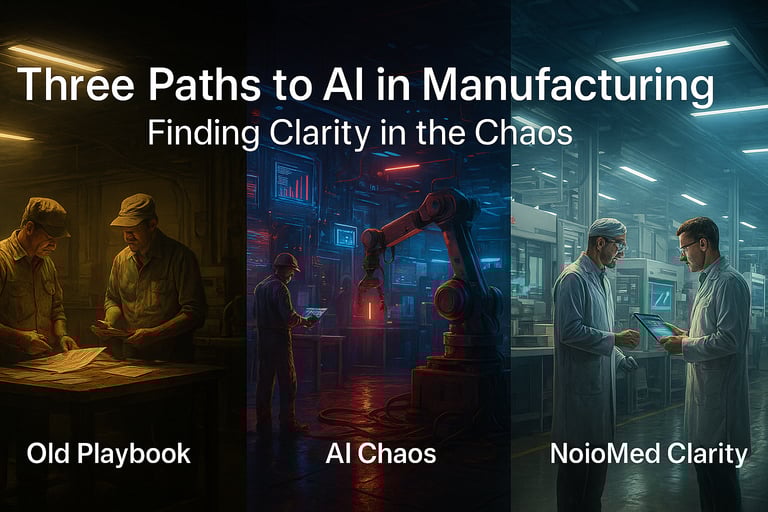
Three Paths to AI in Manufacturing
Why “Old Playbooks” and “AI Hype” Both Miss the Mark. How consulting firms approach AI adoption, and why NoioMed’s pain-point-driven method delivers measurable results.
INTELLIGENT MANUFACTURING TRANSFORMATIONTHE LEARNING LOOP
Manfred Maiers
11/6/20255 min read
Three Paths to AI in Manufacturing: Why “Old Playbooks” and “AI Hype” Both Miss the Mark
How consulting firms approach AI adoption, and why NoioMed’s pain-point-driven method delivers measurable results.
1. When AI Meets the Factory Floor
Artificial Intelligence has become the new buzzword of modern manufacturing. Every month, new tools promise to predict machine failures, improve schedules, and end human error. But after the excitement fades, many executives are left asking the same question:
“Where’s the ROI?”
A 2025 McKinsey study found that while 75% of companies report using AI somewhere in their business, more than 80% have not yet achieved measurable financial impact.
That gap isn’t about the technology—it’s about how organizations are guided through adoption.
Behind most failed AI initiatives lies one of two flawed consulting models:
The “Old Playbook” firms that still rely on pre-AI case studies and manual templates.
The “AI-at-All-Costs” firms that rush to replace everything with agents and dashboards.
And then there’s a third path, the NoioMed approach, which starts not with hype or habit, but with the customer’s real pain points.
Let’s explore how these three philosophies differ, and what they mean for the future of manufacturing.
2. The Old Playbook Approach
“If it worked before, it will still work now.”
These consulting firms have deep experience in Lean, Six Sigma, and Operational Excellence, and that experience is valuable.
But many of them haven’t updated their methods for a world where data, AI, and automation can accelerate improvement.
They continue to deliver workshops with flipcharts, Excel trackers, and post-Kaizen surveys.
Their case studies often date back to the pre-AI era, before predictive analytics or digital twins were part of the conversation.
AI, if mentioned at all, is treated as a buzzword rather than an operational tool.
This approach feels safe, familiar, and proven, but it leads to diminishing returns. The same tools that once delivered breakthroughs now deliver only incremental gains.
Plants improve slowly while competitors move faster, using AI-enhanced decision support and real-time quality feedback loops.
Short-term: Stable and low risk.
Long-term: Falling behind in capability, insight, and competitiveness.
In short: Old playbooks don’t win new games.
3. The AI-at-All-Costs Approach
“Out with the old, agents can do it all.”
At the other extreme are the consulting firms that see AI as a replacement for everything that came before it.
They promise a “factory of the future” by deploying a wave of AI agents to run scheduling, quality, and even supplier management.
On paper, it sounds exciting: a self-optimizing plant driven by machine intelligence.
In practice, it often turns into AI theater, impressive demos that do not scale.
These firms move too quickly to replace proven systems without understanding the process dynamics that made them work in the first place.
They overlook governance, training, and change management. They introduce complexity before maturity.
A McKinsey study on AI transformation found that most projects do not scale because they ignore workflow redesign and accountability.
The result is excessive cost, organizational fatigue, and a credibility gap between the C-suite and the shop floor.
Short-term: Dazzling pilots and marketing buzz.
Long-term: Low ROI, fragmented systems, and frustrated teams.
In short: AI theater doesn’t equal transformation.
4. The NoioMed Approach, Pain Points First, AI Where It Helps
“Start with what’s broken and enhance it intelligently.”
NoioMed bridges the gap between traditional operational excellence and responsible AI.
Our philosophy is simple: AI is not the destination, it’s a tool.
We begin by understanding your true operational pain points, the bottlenecks, data gaps, and decision delays that limit performance, and only then decide whether AI is the right lever to improve them.
This means focusing on fit-for-purpose solutions, not blanket adoption.
If the problem is inconsistent yield, we look at process variation before talking about predictive models.
If maintenance is reactive, we analyze root causes before implementing AI-driven failure prediction.
If CAPA cycles are slow, we enhance workflows with AI retrieval or summarization tools, inside a Responsible AI framework aligned to the NIST AI Risk Management Framework (Govern, Map, Measure, Manage).
By combining the discipline of Lean and Quality Systems with the power of modern AI, manufacturers can accelerate improvement safely and measurably.
Short-term: Fast, targeted wins tied to real KPIs like OEE, FPY, or CAPA closure time.
Long-term: Sustainable capability building, data maturity, and workforce confidence.
In short: Enhance what works. Replace what doesn’t. Measure everything.
5. A Simple Example: Lighting the Factory, Three Ways to Fix the Same Problem
Imagine a manufacturing floor illuminated by rows of linear fluorescent tubes. Over time, some begin to flicker or fail.
Now the question becomes: how do we respond?
The Old Playbook
Replace the broken fluorescent tubes with identical ones.
It’s safe, familiar, and easy. The lights come back on, production continues, and everyone feels productive.
But the energy inefficiency, high maintenance costs, and poor lighting quality all stay.
You’ve fixed the symptoms, not the system.
The AI-at-All-Costs
Remove every fluorescent tube, including the ones that still work. Rewire the entire building with “smart” lights connected to the cloud.
The plant looks futuristic, but it required weeks of downtime and a massive investment.
The system is complex to maintain and offers features that no one asked for.
It’s change for the sake of change, shiny but shallow.
The NoioMed Approach
Disable the old ballasts and replace the broken fluorescent tubes with energy-efficient LED retrofits that fit the existing fixtures.
No unnecessary downtime. No wasted investment. The result is lower energy use, improved lighting, and a clear roadmap for continuous modernization.
It’s practical, efficient, and future-ready, exactly how AI adoption should be handled.
The lighting example may sound simple, but it reflects the decisions manufacturers face every day:
Do we patch what’s broken, rebuild everything from scratch, or modernize intelligently?
At NoioMed, we always choose the third option.
6. Why the NoioMed Approach Works
The secret isn’t in the algorithm; it’s in the alignment.
When AI is introduced after the real problem is understood, it becomes a multiplier of value.
When it’s introduced too early, it becomes a distraction.
That’s why NoioMed follows a three-step framework:
Diagnose the constraint. Find the true performance limit, whether in quality, throughput, or compliance.
Select the right improvement lever. Apply Lean, SPC, or analytics, and add AI only where it accelerates insight or reduces decision latency.
Implement responsibly. Govern with NIST AI RMF principles, train users, and track outcomes with measurable KPIs.
This structured approach ensures that AI adoption enhances, rather than disrupts, your validated processes, quality systems, and compliance envelopes.
7. Closing Thoughts
The race to “do AI” has created two camps: those clinging to old playbooks, and those chasing the next shiny thing.
Both approaches miss the same point, AI is not a replacement for human expertise, it’s an amplifier of it.
Manufacturing success in the AI era won’t come from ignoring technology, nor from overhauling everything overnight.
It will come from those who can identify where the real value lies, in the pain points that slow production, limit yield, or consume resources, and then apply AI responsibly, selectively, and measurably.
At NoioMed, we call this AI-Enhanced Operational Excellence, using intelligence to elevate proven systems, not replace them.
It’s the difference between chasing hype and building capability.
It’s the future of manufacturing, and it’s already here.