Risk-Aware 5S
From Workplace Organization to Compliance Infrastructure. The next evolution of 5S moves from workplace organization toward compliance infrastructure.
INTELLIGENT MANUFACTURING TRANSFORMATIONRISK MANAGEMENTTHE LEARNING LOOP
Manfred Maiers
3/7/20264 min read
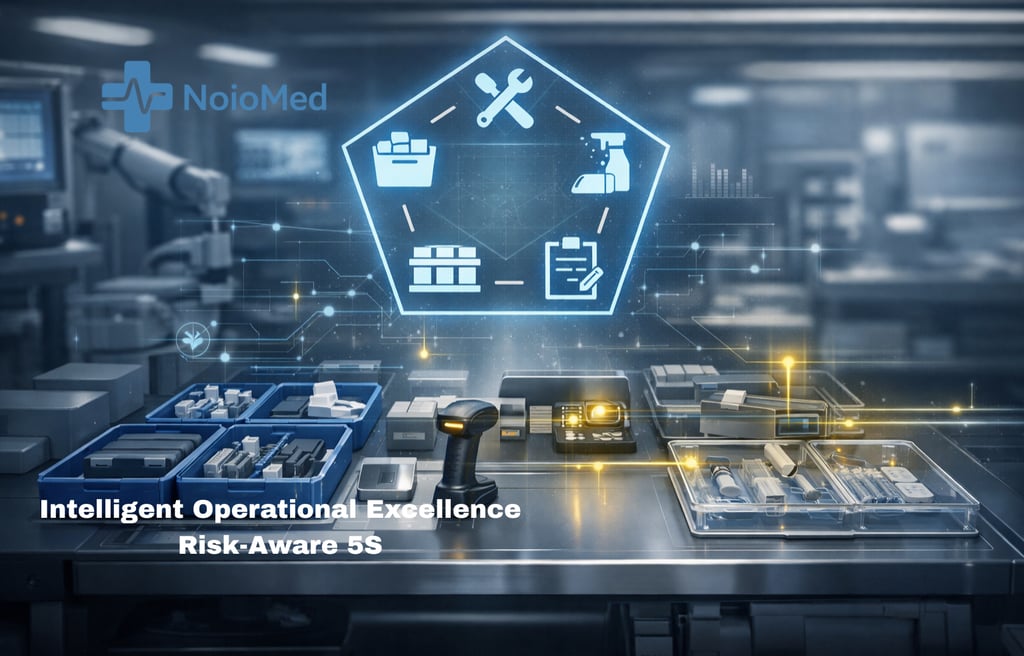
From Workplace Organization to Compliance Infrastructure
Operational Excellence in manufacturing often begins with 5S, one of the most recognizable Lean tools. The method is simple, visual, and powerful. When applied correctly, it creates order, clarity, and operational discipline.
But in regulated medical device manufacturing, the purpose of workplace organization extends far beyond efficiency. A poorly organized workstation is not just a productivity issue. It can become a patient safety risk, a traceability failure, or a regulatory observation.
The next evolution of 5S therefore moves from workplace organization toward compliance infrastructure.
This is the foundation of Risk-Aware 5S.
The Traditional Role of 5S
5S is built around five core principles:
Sort – Remove unnecessary items from the workspace.
Set in Order – Arrange tools and materials so they are easy to access and return.
Shine – Maintain cleanliness and equipment condition.
Standardize – Establish consistent organizational rules.
Sustain – Maintain discipline through routine audits.
In traditional Lean environments, 5S delivers measurable operational benefits:
Reduced motion waste.
Faster tool retrieval.
Clear visual organization.
Improved workplace discipline.
Lower equipment downtime due to improved cleanliness.
A well-implemented 5S environment allows operators to focus on value-added activities rather than searching for tools or navigating cluttered workspaces.
For many industries, these benefits are sufficient.
But in MedTech manufacturing, efficiency is only one dimension of operational performance.
The Structural Limitation of Traditional 5S in MedTech
Medical device manufacturing operates under strict regulatory frameworks such as:
FDA Quality Management System Regulation (QMSR)
ISO 13485
EU MDR
These frameworks emphasize:
traceability
product identity control
contamination prevention
documentation integrity
error prevention
Traditional 5S was never designed to address these regulatory concerns.
As a result, many manufacturing environments appear visually organized while still containing hidden compliance risks.
Common examples include:
Component Mix-Up Risk
Two similar connectors stored near each other can be easily confused during assembly.
Traditional 5S may place both in labeled bins.
Risk-Aware 5S requires physical segregation and identity verification controls.
Traceability Integrity
Lot numbers and material identities must remain connected to the product throughout production.
If materials are reorganized without traceability control, lot identity may be lost.
Labeling Control
Printed labels stored improperly can introduce risks of incorrect labeling, duplicate labels, or label mix-ups.
Documentation Protection
Device History Records (DHRs), batch records, and inspection documentation must remain protected from damage, contamination, or loss.
Contamination Risk
In sterile device manufacturing, workspace organization must support contamination barriers, not just cleanliness.
These risks are rarely addressed in traditional 5S audits.
Risk-Aware 5S: Embedding Compliance into Workplace Design
Risk-Aware 5S extends the traditional model by integrating quality and regulatory controls directly into workplace organization.
Instead of asking only:
"Is the workspace organized?"
Risk-Aware 5S asks:
"Does the workspace prevent errors and protect compliance?"
Several new design elements emerge.
Component Segregation Controls
Risk-Aware workstations separate components based on risk of misidentification.
Controls may include:
physical separation of similar parts
color-coded storage zones
part-specific containers
barcode verification points
This reduces the probability of assembly errors caused by visually similar components.
Lot Traceability Zones
Workstations are organized to maintain clear material identity boundaries.
Examples include:
dedicated areas for active production lots
visual lot segregation markers
controlled WIP staging zones
These measures ensure lot identity remains intact throughout the process.
Labeling Verification Points
Labels represent one of the most critical identity controls in medical devices.
Risk-Aware 5S incorporates:
controlled label storage locations
label reconciliation areas
scanning verification points before application
These transforms labeling from a manual step into a controlled identity checkpoint.
Document Control Integration
Production documentation must remain accessible while protected.
Risk-Aware 5S integrates:
defined locations for batch records
protective document holders
digital workstation displays
controlled document retrieval zones
The workspace supports documentation integrity instead of exposing records to damage or loss.
Contamination Risk Barriers
Cleanliness in MedTech is not only aesthetic. It protects product safety.
Risk-Aware 5S includes:
defined contamination boundaries
controlled cleaning tools
dedicated equipment zones
restricted material pathways
These physical design choices support contamination control strategies required for sterile or high-reliability devices.
Example: Infusion Pump Assembly
Consider an assembly workstation producing infusion pumps.
Several components may appear visually similar:
silicone tubing
pressure connectors
check valves
fluid line adapters
If stored too closely together, operators may select the wrong component.
Traditional 5S might simply organize these parts into labeled bins.
Risk-Aware 5S introduces additional safeguards:
physical separation of similar components
color-coded trays
barcode confirmation before assembly
lot-segregated material zones
The workstation layout itself becomes an error-prevention mechanism.
This reduces the likelihood of assembly errors that could lead to field failures.
Measuring the Effectiveness of Risk-Aware 5S
Operational excellence requires measurable results.
Risk-Aware 5S introduces new performance indicators beyond standard 5S audit scores.
Key metrics include:
Mix-Up Incidents
Number of component identification errors detected during production or inspection.
Labeling Errors
Frequency of incorrect label application or reconciliation discrepancies.
Traceability Deviations
Occurrences where material identity or lot information become unclear.
Component Verification Failures
Barcode or identity verification mismatches detected during assembly.
These metrics reveal whether the workplace design effectively supports error prevention and regulatory compliance.
Strategic Implications for Leadership
Risk-Aware 5S changes how leaders view workplace organization.
Traditionally, 5S was considered a productivity improvement tool.
In regulated manufacturing, it becomes part of the quality system architecture.
This shift has several implications.
First, 5S becomes part of risk management. Workspace organization actively reduces the probability of assembly errors and traceability failures.
Second, audit readiness improves. When auditors examine how identity and traceability are protected, the controls are visible directly within the operational environment.
Third, operator performance improves. Workstations designed for clarity and risk prevention reduce cognitive load and human error.
Finally, patient safety improves. Many product failures originate from simple human errors such as part mix-ups or incorrect labeling. Risk-Aware 5S addresses these risks at the source.
From Workplace Organization to Operational Safeguard
Lean tools were never meant to remain static.
They evolve as industries evolve.
In medical device manufacturing, operational tools must support patient safety and regulatory compliance, not just efficiency.
Risk-Aware 5S demonstrates how a familiar Lean method can evolve into something far more powerful.
The workspace itself becomes a system of safeguards.
When workplace organization actively prevents identity errors, protects traceability, and supports compliance, 5S is no longer just a housekeeping tool.
It has become a structural component of Intelligent Operational Excellence.