
Local AI: Why Local Data Drives AI Success on the Factory Floor (Part 1)
When Global Knowledge Isn’t Enough — Why Local Data Drives AI Success in the Plant
AI-ENHANCED OPERATIONAL EXCELLENCE
Manfred Maiers
10/22/20254 min read
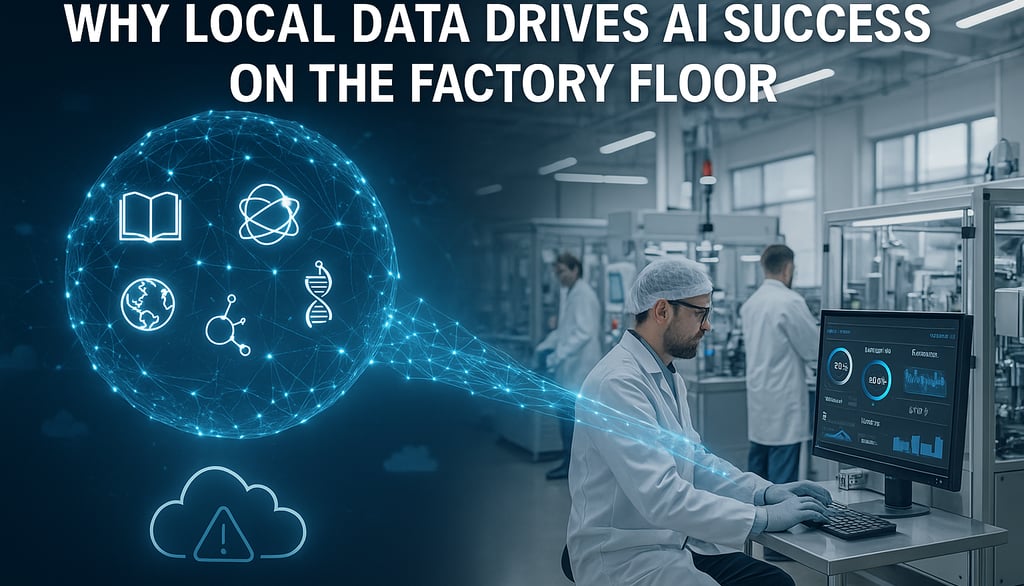
🏭 When Global Knowledge Isn’t Enough: Why Local Data Drives AI Success on the Factory Floor
In the age of large language models (LLMs), we often marvel at the vast reach of global AI. These systems can quote Hemingway, explain quantum entanglement, or describe how to grow orchids.
But none of that helps you when your molding press alarms at 2:00 a.m. or your assembly line grinds to a halt because of a recurring process deviation.
That’s the paradox of AI in manufacturing: global knowledge is abundant, but local insight, data, and resilience are what create value.
1️⃣ Start with the pain point.
Every meaningful improvement starts with a local question:
“Why did our scrap rate increase this quarter?”
“Why does downtime spike on the second shift?”
“Why are we missing delivery targets even with the same headcount?”
These are not global challenges; they’re local realities. They depend on your people, your machines, and your processes.
A cloud-based AI model can give you general advice about how other plants improved their OEE, but it can’t tell you why your Line 3 runs slower after tool changes or why your rework rates climb after preventive maintenance.
To answer those questions, AI needs local data and context.
2️⃣ Add structure: context is everything.
Before AI can help, it must understand the structure of your operation:
📍 Facility location, size, and layout
🏭 Product mix and process complexity
👷 Workforce experience, shifts, and staffing levels
⚙️ Machines, automation systems, and control architectures
🧩 Historical performance, maintenance, and quality data
Without that foundation, even the smartest model is operating blind. As SEMI’s Smart Manufacturing whitepaper notes: “Data integrity and contextual relevance are the stepping stones to the factory of the future.”
3️⃣ Layer in real-time local data
Once the structure is mapped, true insight comes from real-time data streams that reveal how your factory performs.
Include metrics such as:
Scrap and rework rates.
OEE (availability, performance, quality)
Backlog and on-time delivery.
Machine downtime, MTTR, and maintenance logs
Energy consumption and cost per unit
Workforce turnover and cross-training
When AI models are fed with clean, localized, and time-stamped data, they can detect anomalies, predict failures, and recommend targeted actions.
The World Economic Forum recently reported that manufacturers applying AI to live plant data achieved up to 66% defect reduction in precision processes, proof that local data transforms AI from descriptive to prescriptive.
4️⃣ Why generic third-party LLMs often fall short.
Generic cloud-based LLMs have incredible breadth of knowledge, but they typically lack the depth of local context. They may not have access (or permission) to your proprietary plant data, machine logs, real-time telemetry, or internal workflows. This means:
They can’t meaningfully model your specific process flows.
They may miss nuances, how one line interacts with another, how a shift hand-over works, or how your changeovers are performed.
You risk cybersecurity and proprietary data leakage when sending sensitive local data to a third-party cloud environment. As Foley & Lardner LLP notes, data privacy stays one of the most critical barriers to AI adoption in manufacturing.
And perhaps most importantly, you become dependent on external cloud stability. The recent Amazon AWS outage disrupted hundreds of global services, from e-commerce to healthcare to manufacturing analytics. For companies relying entirely on cloud-based AI for real-time decisions, those few hours of downtime meant lost visibility, delayed responses, and halted automation.
In contrast, a smaller, dedicated local LLM, trained solely on your plant’s data and running on-premises or within a secure private cloud, can deliver both precision and reliability. It focuses on your specific pain points, ingests your telemetry, learns your shift patterns and machine behaviors, and provides actionable recommendations without broadcasting sensitive information. And unlike public cloud systems, it keeps running even when the global cloud goes dark.
5️⃣ Local LLMs: the foundation for stability and control
A plant-level or hybrid AI model keeps intelligence close to where work happens.
It integrates directly with your MES, ERP, QMS, and control systems.
It works in real time, without internet latency.
It preserves confidentiality and supports compliance (e.g., FDA 21 CFR 820, ISO 13485).
It strengthens business continuity when external services fail.
In short: when your AI lives in your factory, your factory doesn’t stop thinking when the internet does.
6️⃣ The Plant-Centric AI Stac
This framework transforms AI from a theoretical tool into a reliable operational partner.
7️⃣ Conclusion: local knowledge + local data = AI value
In a world where LLMs appear to “know everything,” it’s tempting to think they can solve every problem. But in the gritty reality of the factory floor, global knowledge alone doesn’t create value. What does is local knowledge, clear context, and real-time plant data. When you combine that with a well-designed, secure, and fit-for-purpose AI system, ideally tailored for your plant, you unlock the kind of insights and actionable support that move the needle.
And in a time when even major cloud providers like Amazon AWS experience outages that can disrupt production visibility and automation, relying solely on external cloud infrastructure introduces unnecessary risk. Local or hybrid LLM architecture minimizes that dependency, ensuring your AI stays operational, stable, and secure, even when the global cloud goes dark.
If you begin with your pain points, layer in the structure of your plant, feed real-time metrics, and choose an AI model architecture that protects your data and focuses on your context, you’re not just deploying an AI: you’re building a smarter, more resilient manufacturing engine.