Keeping AI Honest
How to Synchronize Local RAG and Knowledge Graph Systems with Your Document Control in Regulated Industries
THE LEARNING LOOPAI-ENHANCED OPERATIONAL EXCELLENCE
Manfred Maiers
12/13/20258 min read
Keeping AI Honest:
How to Synchronize Local RAG and Knowledge Graph Systems with Your Document Control in Regulated Industries
Artificial intelligence has created new opportunities for quality, engineering, and regulatory teams across MedTech, Pharma, and Defense. Local large language models, Retrieval Augmented Generation systems, and enterprise knowledge graphs can finally unlock the information buried inside decades of procedures, work instructions, validation records, PFMEAs, technical files, complaint histories, manufacturing records, and risk documentation.
However, a difficult reality follows. These AI systems are only as trustworthy as the data they are allowed to ingest. If your RAG index or knowledge graph becomes out of sync with controlled information, the AI may start generating answers based on outdated, superseded, or unauthorized content. In a regulated industry, this is not a minor error. It is a compliance failure with direct consequences for product safety, traceability, and regulatory confidence.
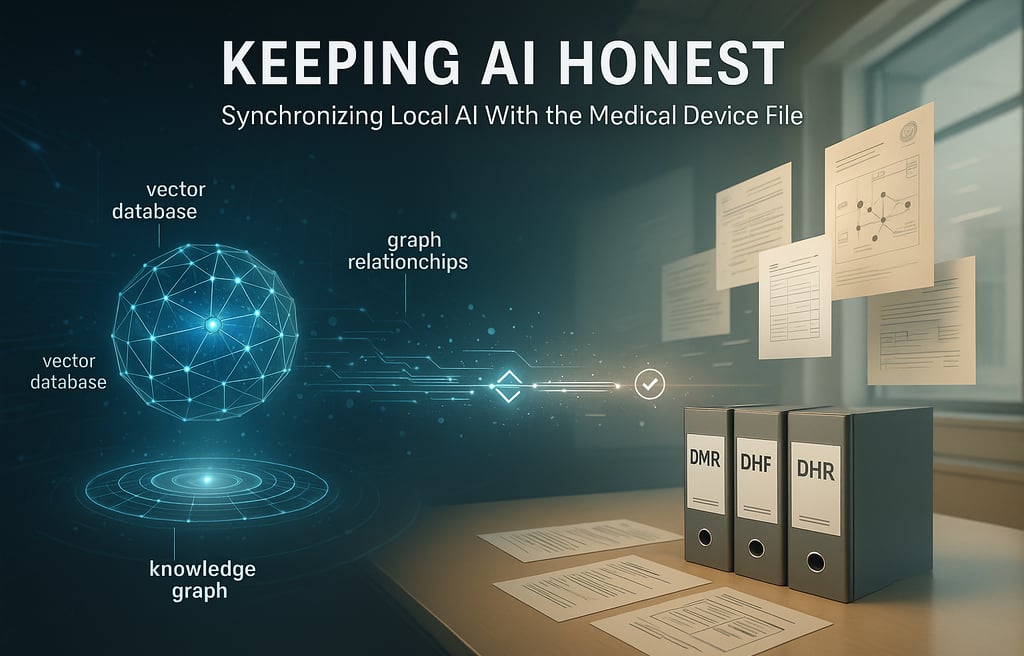
Local AI systems promise improved security, full traceability, and a higher level of control. But achieving those promises requires solving one of the most underrated challenges in AI governance: keeping the AI data layer synchronized with the authoritative Document Control System and the Medical Device File (MDF). Under ISO 13485 and the new Quality Management System Regulation, the MDF is the combined truth of the device, merging the Device Master Record, Design History File, and Device History Record. Any AI system that relies on stale representations of this information risks undermining the integrity of downstream decision making.
Synchronization must work in both directions. AI must always reflect the current state of controlled documents, and when AI generates new content, that content must be properly routed, reviewed, approved, and recorded within the quality system. Without bidirectional control, organizations risk creating a shadow knowledge ecosystem that no longer aligns with the regulated source of truth.
This article explores the technical, operational, and regulatory challenges of keeping alignment between local AI systems and controlled documentation. It outlines practical solutions and architectural patterns that allow organizations to support audit readiness, information accuracy, and controlled workflows while still receiving help from the power and efficiency of modern AI capabilities.
1. Why Synchronization Is Hard: The Disconnect Between AI Systems and Document Control
Modern document control systems come with strict rules. Every controlled document has an owner, a purpose, an approval workflow, and a clear effective date. Permissions decide who can read, change, or retire documents. The goal is to preserve the integrity of the information that supports design control, manufacturing control, and regulatory submissions.
RAG and Knowledge Graph systems run on completely different logic. They depend on continuous ingestion pipelines, granular segmentation of content, semantic indexing, and complex metadata layers. Instead of treating documents as monolithic units, they break them into smaller cognitive building blocks: paragraphs, sections, entities, relationships, and semantic embeddings.
A small revision in a controlled document can invalidate dozens or hundreds of these AI level representations. A minor update to a risk control measure or a manufacturing step may require a full regeneration of embeddings, a re-extraction of entities, and a restructuring of graph relationships.
This mismatch between document control practices and AI ingestion requirements is the root of the synchronization challenge. Without a deliberate, well-engineered strategy, organizations inevitably end up with AI systems that know yesterday’s truth, not today’s.
2. Understanding the Sync Gap: What Actually Goes Out of Sync
The sync gap involves far more than outdated text. Several categories of information can drift in ways that create audit and safety risks.
Content staleness. If embeddings or graph nodes are based on retired or superseded content, the AI may suggest obsolete work instructions or outdated risk mitigations.
Metadata drift. The controlled system may update document classifications, approval roles, or linked processes. If the AI layer does not reflect these changes, it creates inconsistencies in how information is retrieved or interpreted.
Permission mismatches. Some documents are restricted to certain teams, sites, or roles. If the AI system does not enforce identical permissions, it becomes a shadow repository that leaks information outside its intended boundaries.
Schema evolution. As companies introduce new AI specific procedures, new risk categories, or updated MDF structures, the AI knowledge graph must evolve alongside them.
In regulated environments, these gaps are not theoretical. They are exactly the types of discrepancies that regulators investigate when assessing data integrity and decision making.
3. How AI Reads Controlled Documents: RAG, Knowledge Graphs, and Their Requirements
To understand the synchronization challenge, it is essential to understand how AI systems consume controlled information. Local AI systems do not read documents the way humans do. They rely on structured representations created from the Medical Device File (MDF). Under ISO 13485 and the new Quality Management System Regulation, the MDF combines three core sets of records: the Device Master Record, the Design History File, and the Device History Record. These are among the most critical and tightly controlled elements of regulated manufacturing.
A Retrieval Augmented Generation system never reads MDF documents directly. It reads semantic embeddings of small, carefully extracted text segments stored in a vector database. These segments may originate from design inputs, design outputs, risk files, manufacturing specifications, inspection steps, labeling definitions, or verification protocols. If any part of the MDF changes, the AI system must detect the change and regenerate all relevant segments to keep alignment.
Knowledge graph systems transform the MDF into a rich, interconnected model of entities and relationships. For example, a single design document may generate:
A node representing the design output.
Nodes representing each subsystem or component.
Nodes describing risks, hazards, or mitigation strategies.
Nodes for manufacturing steps, tooling requirements, or inspection checks
Links to verification evidence or historical build records
Connections to complaints or nonconformance data
This structure allows AI to reason across the entire lifecycle of the device. But it also means that any modification to the MDF can ripple across an entire network of graph elements.
Both RAG and knowledge graph systems therefore require robust mechanisms for change detection, fine grained processing, and event driven propagation. Occasional batch updates are insufficient. Without continuous synchronization, the AI quickly becomes misaligned with the regulated source of truth.
4. Technical Integration Patterns: How to Keep AI Synchronized with Document Control
Organizations typically rely on one of three integration patterns to coordinate updates between controlled documents and AI representations.
4.1 Scheduled Batch Ingest
This is the simplest approach. The AI system periodically reprocesses all effective documents, usually on a nightly or weekly schedule. While this may be sufficient for pilot deployments, it introduces predictable staleness and requires significant computational resources. In fast moving environments, a delay of even one day may be unacceptable.
4.2 Event Driven Ingestion Using System Hooks or Change Data Capture
This is the preferred long-term model. When a controlled document is revised or approved, the system emits a change event. An ingestion pipeline intercepts the event and updates only the modified content, reducing latency while minimizing reprocessing.
If the document control platform does not support native event hooks, Change Data Capture tools can check the underlying database for approved changes and publish structured notifications. This approach aligns AI freshness directly with the controlled document lifecycle.
4.3 Data Fabric or Content Bus Architecture
In organizations with multiple systems of record such as PLM, ERP, QMS, manufacturing execution systems, and training platforms, a unifying content bus provides a stable middle layer. It normalizes metadata, aligns document identifiers, and distributes controlled content consistently to downstream systems including RAG and knowledge graphs.
This architecture offers scalability and consistency but requires strong governance and investment in data infrastructure.
5. Solving Access Control and Compliance: Aligning Permissions Across Systems
AI systems must enforce the same access restrictions as the controlled document environment. Without this alignment, users may gain unauthorized access to sensitive design files, investigation records, or proprietary manufacturing details.
Two enforcement patterns are common:
Permission aware indexing. Each chunk or graph node carries access metadata that mirrors the original controlled document's permissions. Retrieval is filtered based on the authenticated user's access rights.
Pass through authorization. Instead of storing document content in the AI index, the system stores pointers that are resolved through the document control system at query time. This ensures real time permission enforcement.
Either approach must be rigorously validated to satisfy regulatory expectations around data integrity and access control.
6. Managing Versions and Traceability: How to Keep AI Outputs Aligned with Controlled Revisions
Version control is central to regulated product development. If the AI system references an outdated revision of a design file or risk control, its output may compromise product safety or regulatory compliance.
To keep alignment, organizations must treat version metadata as a core part of their AI architecture. Both the RAG index and knowledge graph should store revision identifiers, effective dates, supersession logic, and status flags.
When a new revision becomes effective, older versions must be retired or clearly excluded from retrieval. The system must also track which revision was referenced by the AI at the time a decision or document was generated. This provides essential context during audits and supports the organization’s data integrity narrative.
7. The Hardest Part: Bidirectional Synchronization When AI Generates New Content
Most organizations begin by focusing on the inbound direction: controlled documents flowing into the AI system. The outbound direction is equally important.
AI systems increasingly generate:
Draft SOP or work instruction updates
CAPA investigation text
Complaint summaries
Risk analysis descriptions.
Design documentation
Manufacturing troubleshooting insights
None of these can bypass change control. The quality system must remain the only authoritative source of controlled documents.
A robust bidirectional workflow includes:
AI generates a draft. The draft is stored in an AI workspace with clear metadata: source citations, model version, retrieval context, and timestamp.
Human review. SMEs and QA reviewers evaluate and refine the draft.
QMS routing. The draft enters the formal approval workflow.
Publication. Once approved, the controlled system publishes the final document.
Re ingestion. The synchronization pipeline updates the RAG and knowledge graph to reflect the new approved content.
This prevents AI from creating shadow documentation while still enabling significant productivity gains.
8. Creating Provenance and Trust: Linking AI Outputs Back to Their Sources
Regulators increasingly ask how companies ensure AI generated content is based on correct and current source material. Provenance is the answer.
A robust provenance chain includes:
A record of which documents and revisions the AI retrieved.
The version of the embedding index or knowledge graph used.
The model version
The precise input prompt and retrieval context
A timestamped audit log
Knowledge graphs are particularly powerful for provenance. They allow organizations to model relationships between AI work items, controlled documents, source revisions, CAPA records, and final outputs. This becomes a living map of how AI influences regulated work.
9. A Recommended Future Architecture for Regulated AI
A mature AI ecosystem in regulated industries has six foundational components:
1. Document Control stays the authoritative source.
The MDF and controlled document environment always define the truth.
2. A synchronization service monitors changes.
It consumes events, detects updates, and prepares modified documents for AI processing.
3. RAG indexes and knowledge graphs are continuously updated.
The system processes changes with minimal latency and strong metadata governance.
4. AI tools use secure local models.
They enforce permissions, record citations, and reference only effective controlled content.
5. AI generated content enters a controlled drafting workspace.
No output becomes official until routed and approved through proper workflows.
6. Approved content flows back into the AI environment.
The cycle repeats, ensuring the AI always reflects the latest state of the device and its documentation.
This architecture enables AI innovation without compromising safety, quality, or regulatory expectations.
10. Conclusion: AI Can Strengthen Regulated Quality Systems Only if It Is Properly Synchronized
Local AI systems offer enormous potential for regulated industries. They can accelerate investigations, improve risk management, simplify documentation, and enhance design and manufacturing insight. But they can only strengthen compliance when synchronization with controlled documentation is reliable and complete.
When AI systems drift out of sync, they become a liability. When synchronization is engineered correctly, they become one of the most valuable tools available to modern quality and engineering organizations.
Companies that invest early in synchronization infrastructure, metadata governance, and controlled bidirectional workflows will be ready for the next decade of AI enabled product and quality management. Those who ignore these requirements risk introducing uncontrolled AI behavior that undermines the integrity of their regulated systems.