Intelligent Gemba Walks
From Observation to Risk Detection. Leaders must also detect emerging risks before they turn into quality events, compliance issues, or patient safety problems.
THE LEARNING LOOPINTELLIGENT MANUFACTURING TRANSFORMATIONRISK MANAGEMENT
Manfred Maiers
3/12/20264 min read
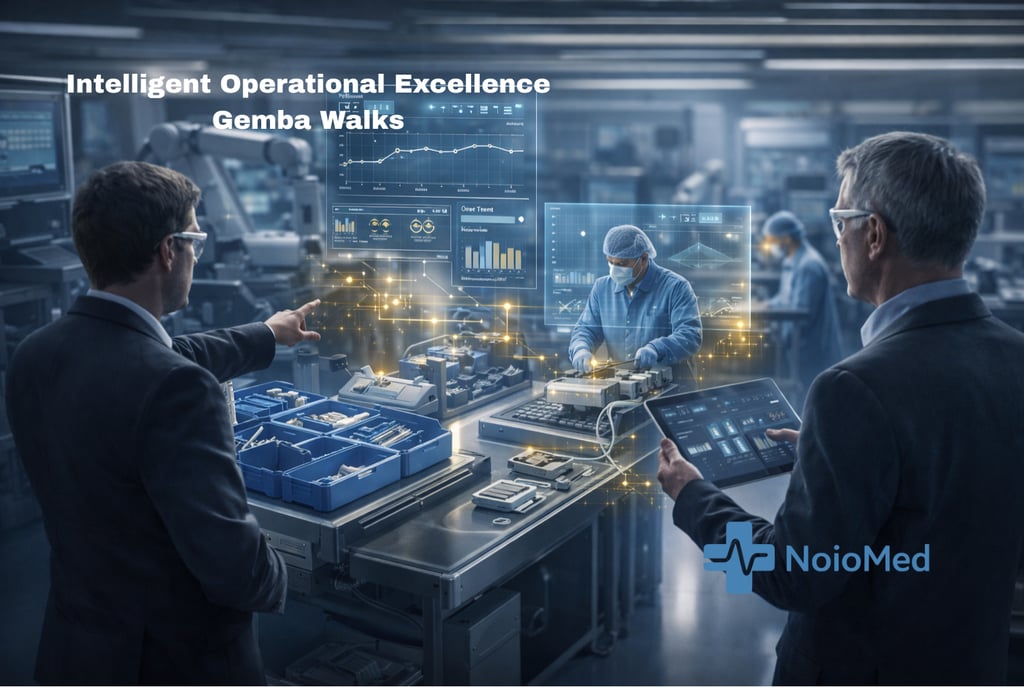

Intelligent Gemba Walks
From Observation to Risk Detection
The Gemba Walk is one of the most recognizable practices in Lean leadership. The idea is straightforward. If leaders want to understand how work truly happens, they must go to the Gemba, the place where the work is performed.
Walking the shop floor, observing processes, and engaging with employees has long been a powerful way to identify inefficiencies and strengthen operational understanding.
But in regulated medical device manufacturing, operational excellence requires more than observation.
Leaders must also detect emerging risks before they turn into quality events, compliance issues, or patient safety problems.
This is where the concept of the Intelligent Gemba Walk emerges. The practice evolves from observation to risk detection.
Core Lean Tool
Gemba Walks
A Gemba Walk is a management practice used in Lean and Six Sigma methodologies where leaders visit the place where work is done to observe processes and engage with employees. The purpose is to understand operations firsthand and identify opportunities for improvement.
Gemba walk on steroids
Common variations of the practice include:
management walkaround
shop floor walk
process walk
workplace walkthrough
“go and see”
Regardless of terminology, the philosophy remains the same. Leadership gains understanding by directly observing real work in real environments.
Traditional Lean Perspective
In traditional Lean environments, leaders conduct Gemba walks to understand process flow and identify inefficiencies.
Typical objectives include:
observing how work is performed
identifying bottlenecks
detecting waste
engaging operators in improvement discussions
Leaders ask questions such as:
Where is the process slowing down?
What problems are operators encountering?
Are there unnecessary steps in the workflow?
This approach strengthens communication between leadership and operators and helps uncover improvement opportunities that may not be visible in reports.
However, this model primarily focuses on efficiency and productivity.
In regulated manufacturing, additional dimensions must be examined.
The Structural Limitation
Traditional Gemba walks rarely examine deeper signals that indicate process risk or control effectiveness.
Several critical elements often remain invisible during standard observation:
risk control effectiveness
inspection performance
PFMEA assumptions
training adequacy
From a production standpoint, a process may appear stable. Operators meet cycle targets, equipment runs smoothly, and throughput remains high.
Yet quality risks may be silently accumulating.
For example:
inspection systems may be missing emerging defects
process capability may be drifting toward specification limits
operator training coverage may be incomplete
control plan steps may be inconsistently executed
These factors directly influence regulatory expectations under ISO 13485, FDA QMSR, and ISO 14971, but they are rarely examined during traditional shop floor walkthroughs.
The result is a dangerous illusion of stability.
Intelligent Operational Excellence Extension
Risk-Focused Operational Reviews
Within the Intelligent Operational Excellence framework, Gemba walks evolve into Risk-Focused Operational Reviews.
Instead of simply observing activity, leaders review the health of risk controls and detection systems embedded within the process.
During these reviews, leaders examine signals such as:
inspection escape signals
control plan adherence
detection effectiveness
process capability drift
The Gemba walk becomes structured around operational data and process risk indicators.
Preparation begins before the walk itself.
Operational leaders review performance indicators and trendlines that highlight potential risk areas. These signals guide the focus of the walk, ensuring leadership attention is directed toward the most critical processes.
This approach transforms the Gemba walk into a data-informed operational intelligence activity.
Adding Data: The “Gemba Walk on Steroids”
The integration of performance data dramatically enhances the power of Gemba walks.
When Key Performance Indicators (KPIs) are incorporated into the process, leaders gain measurable insight into how operations are performing.
KPIs provide the operational baseline for understanding process health.
Common manufacturing KPIs include:
production yield and scrap rates
overall equipment effectiveness (OEE)
on-time delivery performance
safety incidents
workforce engagement indicators
These metrics allow leaders to focus attention on areas where performance is drifting or instability may be developing.
Trendlines provide an additional layer of insight by revealing direction of performance over time.
A single yield value may appear acceptable, but a downward trendline may signal emerging process instability.
When trendlines are combined with upper and lower specification limits, organizations can define acceptable performance boundaries.
If performance approaches or crosses these limits, predefined responses (OKRs) can be triggered.
This transforms the Gemba walk from passive observation into proactive operational monitoring.
Example
Disposable Infusion Set Molding Line
Consider a molding line producing disposable infusion set components.
Production data shows that the line is meeting all cycle time targets. Output levels remain stable and production throughput is high.
A traditional Gemba walk would likely conclude that the process is performing well.
However, deeper analysis reveals an emerging issue.
Inspection data shows a gradual increase in inspection escape events downstream.
Defective components are slipping through detection systems more frequently.
Operators are meeting cycle time targets, and the process appears stable from a productivity perspective.
But the inspection system is becoming less effective at detecting variation.
Because traditional Gemba walks focus primarily on efficiency and workflow, this issue might go unnoticed.
In a Risk-Focused Gemba Walk, leaders would examine inspection performance metrics before visiting the line.
During the walk, discussions would focus on:
inspection system sensitivity
process variation in molding parameters
potential material variation
recent changes to tooling or setup
This deeper investigation could reveal subtle process changes that increased defect variability.
Early intervention prevents the issue from escalating into widespread product defects or customer complaints.
Key Metrics for Intelligent Gemba Walks
A structured set of operational indicators supports risk-focused observation.
Key metrics include:
Inspection Escape Rates
Frequency of defects detected after inspection controls should have captured them.
Yield Drift
Subtle shifts in process yield that may indicate emerging instability.
Training Coverage
Verification that operators are properly trained and certified for the processes they perform.
Control Plan Compliance
Confirmation that required process controls are executed consistently on the shop floor.
Monitoring these metrics provides a clear picture of whether operational processes are functioning within their intended risk controls.
Strategic Leadership Insight
When Gemba walks evolve from simple observation to risk detection, leadership visibility changes fundamentally.
The practice becomes a mechanism for real-time risk monitoring rather than only operational observation.
Several strategic advantages emerge.
Earlier Risk Detection
Performance signals reveal emerging problems before they escalate into quality events or regulatory findings.
Stronger Alignment with Risk Management
Daily operational oversight becomes directly connected to PFMEA assumptions and control plan execution.
Better Decision-Making
Leadership can prioritize improvement activities based on measurable risk signals rather than anecdotal observations.
Enhanced Employee Engagement
Operators participate in diagnosing and resolving issues early, strengthening ownership and accountability.
The Future of Gemba Leadership
Lean philosophy emphasizes understanding the real work.
But modern manufacturing leadership must also understand the real risk environment.
When Gemba walks integrate:
operational observation
KPI monitoring
trendline analysis
specification limits
predefined responses (OKRs)
the practice evolves into a powerful system for continuous operational intelligence.
If Risk-Aware 5S transforms the workplace into an error-prevention system, the Intelligent Gemba Walk transforms leadership presence into a system for early risk detection.
Together, they form a critical foundation for Intelligent Operational Excellence in regulated MedTech manufacturing.