Functional Safety Is Not a Feature. It Is the Architecture.
Safety is not added to the design. Safety defines the design. And if you do not let it drive your architecture early, you will spend the rest of the lifecycle compensating for it.
RISK MANAGEMENTTHE LEARNING LOOP
Manfred Maiers
3/25/20264 min read
Functional Safety Is Not a Feature. It Is the Architecture.
Most MedTech teams treat safety as something you add.
A mitigation.
A control.
A line item in the risk file.
But in functional safety, that thinking is backwards.
Safety is not added to the design.
Safety defines the design.
And if you do not let it drive your architecture early, you will spend the rest of the lifecycle compensating for it.
The Silent Gap in MedTech Engineering
In industrial systems, this is explicit.
Standards like ISO 13849-1 and IEC 61508 force a hard linkage between:
Risk reduction requirements
Diagnostic capability
Fault tolerance
And ultimately, system architecture
Higher risk → higher integrity → different architecture.
No debate.
In MedTech, we operate differently.
ISO 14971 gives us a rigorous process.
But it does not prescribe architecture.
It does not tell you:
When you need redundancy
When dual-channel becomes mandatory
When diagnostics must reach a certain threshold
So, what happens?
Two devices with very different clinical risk profiles often end up with very similar architectures.
That is not a compliance issue.
That is an engineering leadership issue.
Architecture Is the Real Risk Control
If a safety function matters, then the system must be architected to:
Detect faults
Tolerate faults
Respond correctly to faults
That is where functional safety lives.
Not in the risk file.
In the structure of the system.
ISO 13849-1 gives us a powerful lens to think about this.
The Architecture Ladder Most MedTech Teams Never Use
Let’s simplify the categories into engineering reality:
Category B / 1
Single channel
Minimal fault tolerance
Relies on component reliability
Failure = loss of safety function
Category 2
Still single channel
Adds periodic diagnostics
Detects faults, but does not prevent them in real time
Category 3
Dual-channel architecture
Tolerates a single fault
Introduces real fault resilience
Category 4
Dual-channel + high diagnostic coverage
Detects faults before they accumulate
Designed for high-risk applications
This is not academic classification.
This is a maturity model of how seriously your architecture treats failure.
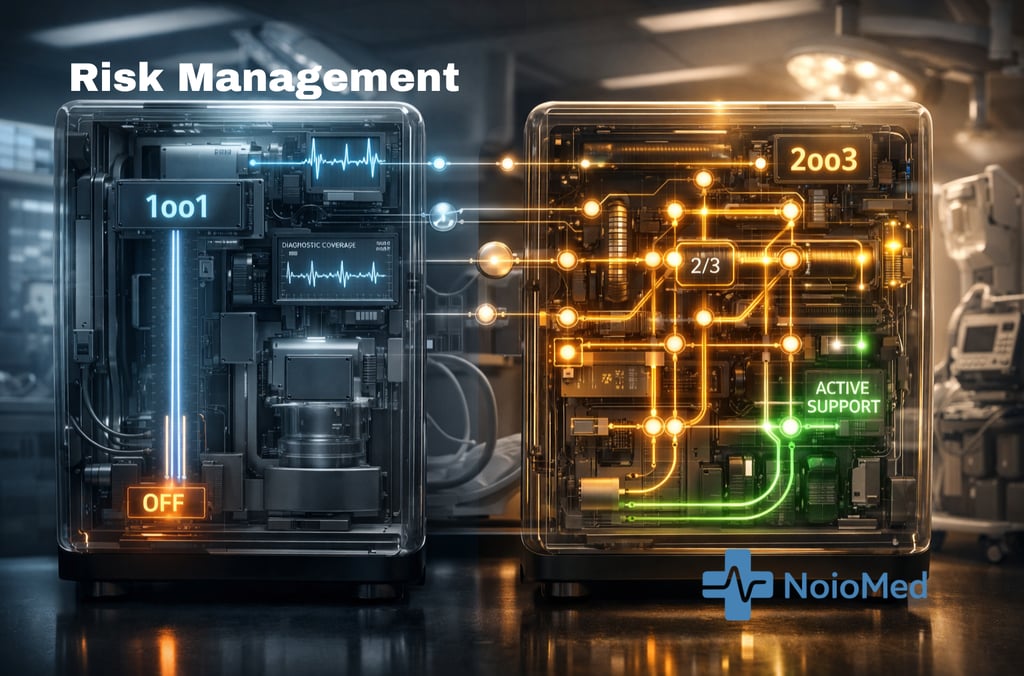
1oo1 vs 1oo2 vs 2oo2 vs 2oo3: The Tradeoffs You Cannot Avoid
These architectures define how your system makes decisions under uncertainty.
1oo1 (One out of One)
One path
No redundancy
Fast, simple, fragile
1oo2 (One out of Two)
Redundant channels
One channel can protect the system
Strong safety performance
Higher complexity
2oo2 (Two out of Two)
Both channels must agree
Reduces nuisance trips
Can block safety action if poorly designed
2oo3 (Two out of Three)
Majority voting
Balances safety and availability
Higher system complexity
Here is the uncomfortable truth:
You are always trading between:
Safety
Availability
Complexity
Cost
If you are not explicitly making this tradeoff, you are making it accidentally.
Single vs Dual Channel: The Illusion of Redundancy
Many MedTech devices claim “redundancy.”
But in reality, they have:
Two sensors feeding the same processor
Two software routines running the same logic
Two channels sharing the same failure mode
That is not redundancy.
That is duplication.
True dual-channel architecture requires:
Independence
Separation
Protection against common cause failure
Otherwise, both channels fail the same way, at the same time.
And your “redundancy” disappears exactly when you need it most.
Diagnostic Coverage: Where Most Designs Fall Apart
Diagnostic Coverage (DC) answers one critical question:
What percentage of dangerous failures do you actually detect?
Not:
“Do we have a watchdog?”
“Do we run a self-test?”
But:
Are we detecting the failures that matter?
Are we detecting them in time?
Low DC gives you visibility.
High DC gives you protection.
And here is the key insight:
You do not achieve high DC by adding features.
You achieve it by designing the architecture differently.
Cross-monitoring.
Independent validation.
End-to-end verification.
This is where Category 4 systems separate themselves.
Safe State Is Not Always “Off”
One of the most critical, and most misunderstood, design decisions:
What is the safe state of your device?
In some cases, it is obvious.
Safe state = OFF
Infusion pump stops delivery
Surgical laser shuts down
But in many MedTech systems, that assumption is wrong.
Safe state = ON
Ventilator must continue airflow
Cardiopulmonary bypass must maintain circulation
Turning off is not safe.
It is catastrophic.
This is the dividing line between:
Fail-safe systems
Fail-operational systems
And it fundamentally changes your architecture.
The MedTech Reality: No One Will Tell You the Right Architecture
Here is the critical insight:
There is no medical device standard that tells you:
Use 1oo2
Use Category 3
Use dual-channel
You must derive it.
From:
Hazard severity
Time to harm
Detectability
Clinical context
This is where engineering maturity shows up.
Not in documentation.
In decisions.
Two Devices. Two Opposite Definitions of Safe
This is where functional safety stops being theoretical and becomes architectural reality.
Infusion System (Safe State = OFF)
Active delivery of medication
Short time-to-harm in case of over-infusion
Primary risk: uncontrolled or excessive delivery
Safe response: stop energy, stop flow
Architecture implication:
Strong fault detection tied to immediate shutdown
Emphasis on interruption capability
Fail-safe design dominates
Ventilator (Safe State = ON)
Sustains respiratory function
Immediate harm if airflow stops
Primary risk: loss of life-support function
Safe response: continue operation, even in degraded mode
Architecture implication:
Fault tolerance over simple shutdown
Redundancy becomes critical
Fail-operational design dominates
Same clinical environment.
Completely different safety philosophy.
In one system, stopping is safe.
In the other, stopping is the failure.
And that single distinction drives everything:
Architecture
Redundancy strategy
Diagnostic approach
System behavior under fault
If you define the safe state wrong,
no amount of risk documentation will fix the design.
Final Thought: This Is Where MedTech Must Evolve
MedTech does not need to copy industrial functional safety.
But it must adopt its mindset.
The future is not:
More documentation
More risk tables
More checklists
The future is:
Architecture as a risk control.
The organizations that win will be the ones that can demonstrate:
The hazard drove the architecture
Architecture enables detection
The system responds correctly
The safe state is intentional
That is how you move from compliant to resilient.
🔶 What Comes Next
In the next article, we will connect this directly to:
FMEA 4.0 and architecture-driven risk modeling
Because if your architecture is not reflected in your DFMEA and PFMEA…
You are not managing risk.
You are documenting it.