From RAG to Knowledge Graphs - How AI Can Finally Connect the Dots in Manufacturing and CAPA (Part 3)
The Next Step in Local AI Evolution - we explored how local data and responsible, on-prem AI systems are reshaping regulated manufacturing.
THE LEARNING LOOPAI-ENHANCED OPERATIONAL EXCELLENCECAPA
Manfred Maiers
11/11/20253 min read
From RAG to Knowledge Graphs - How AI Can Finally Connect the Dots in Manufacturing and CAPA
Introduction: The Next Step in Local AI Evolution
In my recent articles:
👉 “When Global Knowledge Isn’t Enough: Why Local Data Drives AI Success on the Factory Floor,” and
👉 “Production-Grade AI Starts Local: RAG with Compliance and Control,”
we explored how local data and responsible, on-prem AI systems are reshaping regulated manufacturing.
The next logical step in that journey is understanding how these local AI systems can go beyond retrieval, to reasoning.
That’s where Knowledge Graphs come in.
While RAG (Retrieval-Augmented Generation) helps AI systems find relevant information, a Knowledge Graph helps them understand how everything connects.
And for anyone managing CAPA, complaints, risk, or operations in MedTech or manufacturing, those connections matter more than ever.
RAG: The First Step Toward Intelligent Retrieval
Traditional AI chat or document search tools are powered by RAG, systems that retrieve and summarize the most relevant information from your local documents.
Ask a RAG system, “What’s our CAPA procedure?” and it can quote your SOP precisely.
But RAG has limits. It sees words, not relationships.
It can pull text about a specific complaint or failure mode, but it can’t recognize that both were tied to the same equipment or supplier change.
In other words:
RAG gives you knowledge in pieces, but not the story that connects them.
The Power of Knowledge Graphs: Context That Thinks in Connections
A Knowledge Graph (KG) changes that.
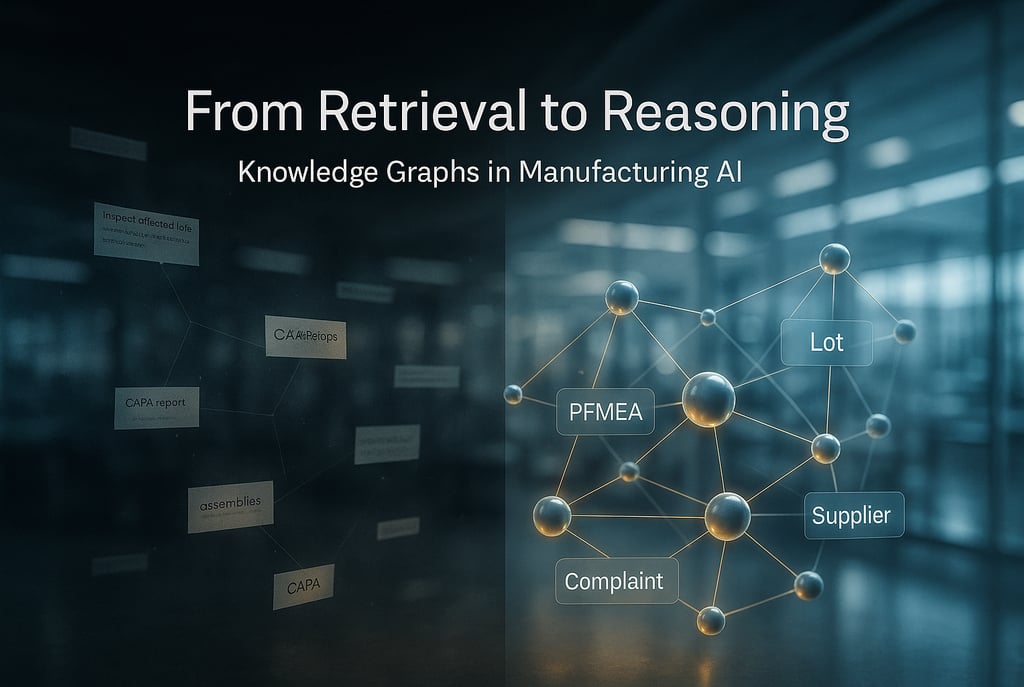
It turns your data into a network of entities and relationships, connecting people, parts, lots, machines, documents, and decisions.
Think of it as a digital map of your operations:
A part belongs to a lot,
that lot was built on a specific line,
using equipment with a calibration record,
operated by a trained individual,
under PFMEA control,
linked to a CAPA cause and supplier change.
Each of these becomes a node in the graph, and every connection between them is traceable, searchable, and auditable.
That’s how a Knowledge Graph moves beyond information access to real operational intelligence.
Why Knowledge Graphs Are a Leap Beyond RAG
Retrieval vs. Reasoning
RRAG retrieves text chunks that look relevant.
A Knowledge Graph retrieves relationships, how different data points relate, interact, and evolve.
Context and Causality
RAG can tell you what happened.
A Knowledge Graph helps uncover why it happened, by following connections across complaints, lots, and process history.
Traceability and Trust
RAG provides citations.
A Knowledge Graph provides auditable relationship paths, showing exactly how the AI reached its conclusion, critical in regulated industries like MedTech.
From Summarization to Investigation
RAG is excellent for summarizing documents.
A Knowledge Graph empowers cross-silo investigations, turning disconnected records into a unified cause-and-effect chain.
With a Knowledge Graph, you’re no longer searching documents.
You’re exploring systems and finding patterns you didn’t know existed.
CAPA Reimagined: Turning Data Islands into Connected Intelligence
A CAPA investigation is never just one dataset.
It spans your MES, PLM, QMS, supplier audits, training logs, and risk files. Each system tells part of the story, but in isolation, they can obscure the real root cause.
Here’s what a connected CAPA investigation looks like with a Knowledge Graph in place:
Complaints automatically link to related failure modes.
Failure modes connect to PFMEA causes and controls.
Lots trace back to specific equipment and calibration records.
Suppliers tie to ECOs or material changes.
Operators link to training verification records.
The result is a living web of relationships that lets quality leaders see not just what happened, but what else is connected.
Instead of days spent chasing spreadsheets and cross-referencing documents, the investigation unfolds as a visual and logical narrative.
Local LLMs + Knowledge Graphs = Secure Factory Intelligence
For regulated manufacturers, where and how AI works matters as much as what it can do.
That’s why NoioMed advocates local LLMs, models that run within your controlled infrastructure, not in the public cloud.
When combined with a Knowledge Graph, these local systems can reason across your data while keeping full confidentiality and traceability.
They can answer complex questions like:
“Which complaints share root causes with open CAPAs?”
“Are there suppliers linked to multiple deviations this quarter?”
“What risk controls are affected by this new ECO?”
And because the model never leaves your firewall, your data never fuels anyone else’s AI.
The Business Impact: From Reactive to Preventive Quality
Decision makers don’t need another dashboard, they need clarity.
By connecting data across departments, a Knowledge Graph provides a foundation for:
Faster Root Cause Analysis, connecting nonconformances, processes, and risk in hours, not weeks.
Proactive Prevention, finding recurring patterns before they escalate into CAPAs.
Audit Readiness, every AI-generated insight can trace back to verifiable records.
Smarter Resource Use, teams focus on solving problems, not searching for data.
It’s not just smarter AI; it’s a smarter organization.
At NoioMed, We’re Building This Future
At NoioMed, we’re integrating Knowledge Graphs into our CAPA360 and AI with Integrity frameworks, bringing structured intelligence to regulated operations.
By connecting data through governed, auditable relationships, we help manufacturers achieve what’s long been promised but rarely delivered:
a quality system that actually learns.
Because in manufacturing, and especially in MedTech, connecting the dots isn’t a luxury.
It’s how you stay compliant, efficient, and ahead of risk.