
FMEA 4.0 Extending the Schema With Functional Safety, Action Priority & Full Traceability (ARTICLE 6)
Risk Graphs, and Full Lifecycle Traceability How to transform FMEAs into a unified risk intelligence platform for design & manufacturing
THE LEARNING LOOPINTELLIGENT MANUFACTURING TRANSFORMATIONRISK MANAGEMENT
Manfred Maiers
1/17/20264 min read
1. From Risk Register to Risk Intelligence Backbone
A modern FMEA database cannot stop at S–O–D scoring and failure rows.
Traditional FMEAs were built as structured documents. FMEA 4.0 is built as a structured risk intelligence system.
Once severity is anchored to shared Potential Effects of Failure and risk items are connected across DFMEA and PFMEA, the schema becomes more than a scoring tool. It becomes the backbone of lifecycle traceability.
The next logical step is extending that backbone to support:
Functional Safety reasoning
AIAG & VDA Action Priority logic
Full traceability from harm to process parameter
Governance-ready digital thread architecture
This article explains how those layers integrate into the updated FMEA 4.0 schema without fragmenting severity or duplicating logic.
2. Severity First: The Common Thread Between Functional Safety and AP
Before extending the schema, it is important to clarify a core principle:
Both Functional Safety and Action Priority start with consequence.
Traditional RPN
RPN compresses Severity, Occurrence, and Detection into a single number. It enables ranking but hides structure. Two risks with very different severity profiles can produce identical RPNs.
AIAG & VDA Action Priority
Action Priority was introduced to address weaknesses in pure RPN ranking. It uses a logic table driven primarily by Severity, then moderated by Occurrence and Detection. It forces action when Severity is high, regardless of mathematical equivalence.
AP is not a new risk metric. It is a decision-forcing governance mechanism.
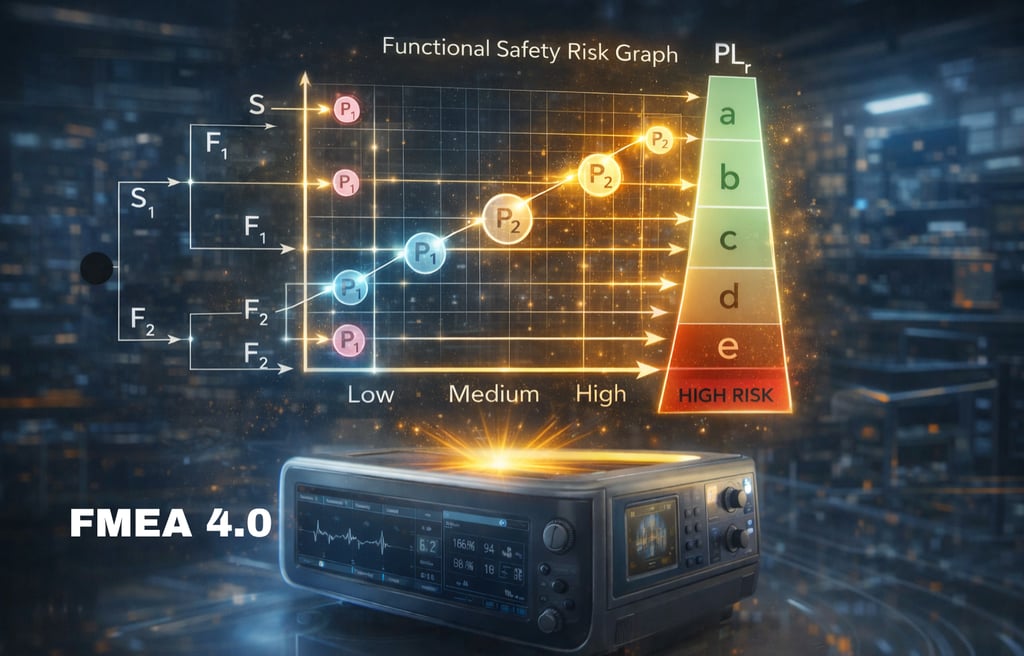
Functional Safety Risk Graph
Functional Safety frameworks such as ISO 26262 use:
Severity
Exposure
Controllability
These dimensions classify harm and lead to Safety Integrity Levels or ASIL ratings. Again, consequence drives the logic.
The Structural Insight
If severity lives on the failure mode row, the system fragments.
If severity lives on the Potential Effect of Failure, the system stabilizes.
Both AP and Functional Safety are most logically attached to the effect layer, not the failure mode layer. The updated schema reflects this.
Comparison Overview
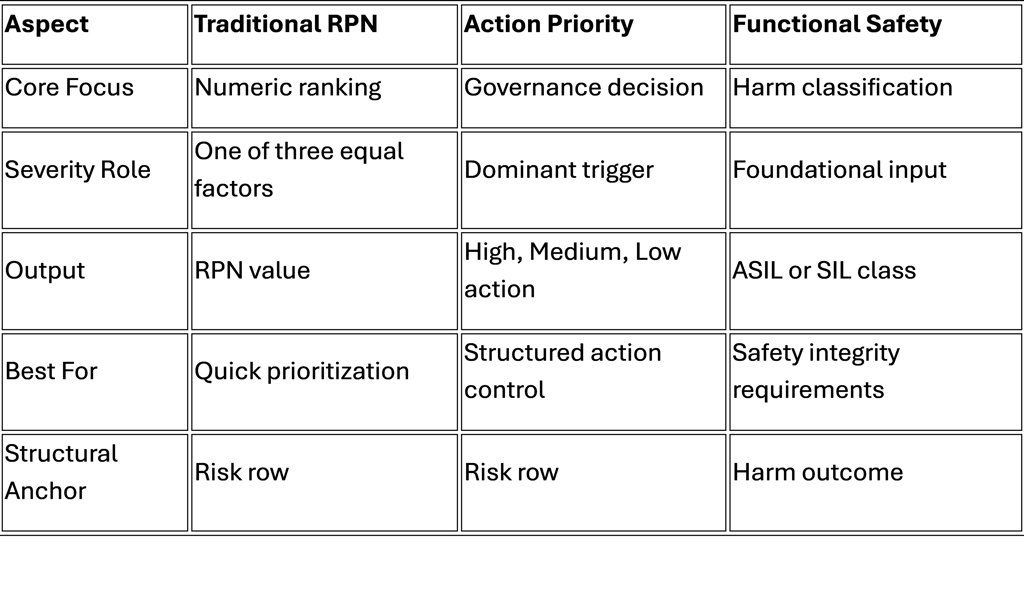
In FMEA 4.0, all three approaches are supported without duplicating severity logic.
3. Extending the Schema for Functional Safety
To support Functional Safety, the schema introduces a conceptual extension layer attached to Potential Effects of Failure.
Each effect can include:
Severity_FS
Exposure_FS
Controllability_FS
RiskGraphResult
SafetyGoal reference
By attaching Functional Safety attributes to the effect entity:
DFMEA and PFMEA risks referencing the same effect inherit consistent safety classification.
Manufacturing escapes and design defects converge on the same safety integrity logic.
Safety goals can be traced directly to specific harm.
This preserves the integrity of harm modeling and prevents duplicated safety classifications across lifecycle phases.
4. Integrating Action Priority into the Schema
Action Priority is derived from S–O–D combinations.
In the database:
Severity is derived from the linked effect.
Occurrence and Detection remain risk-item specific.
AP is calculated deterministically based on standardized logic tables.
AP is stored as:
A derived classification
An action governance attribute
A workflow trigger for escalation
AP does not replace severity. It governs response intensity.
Because severity is centralized at the effect level, AP calculations remain consistent across products and phases.
5. Full Lifecycle Traceability
Once shared effects, AP logic, and Functional Safety attributes are in place, traceability becomes structural.
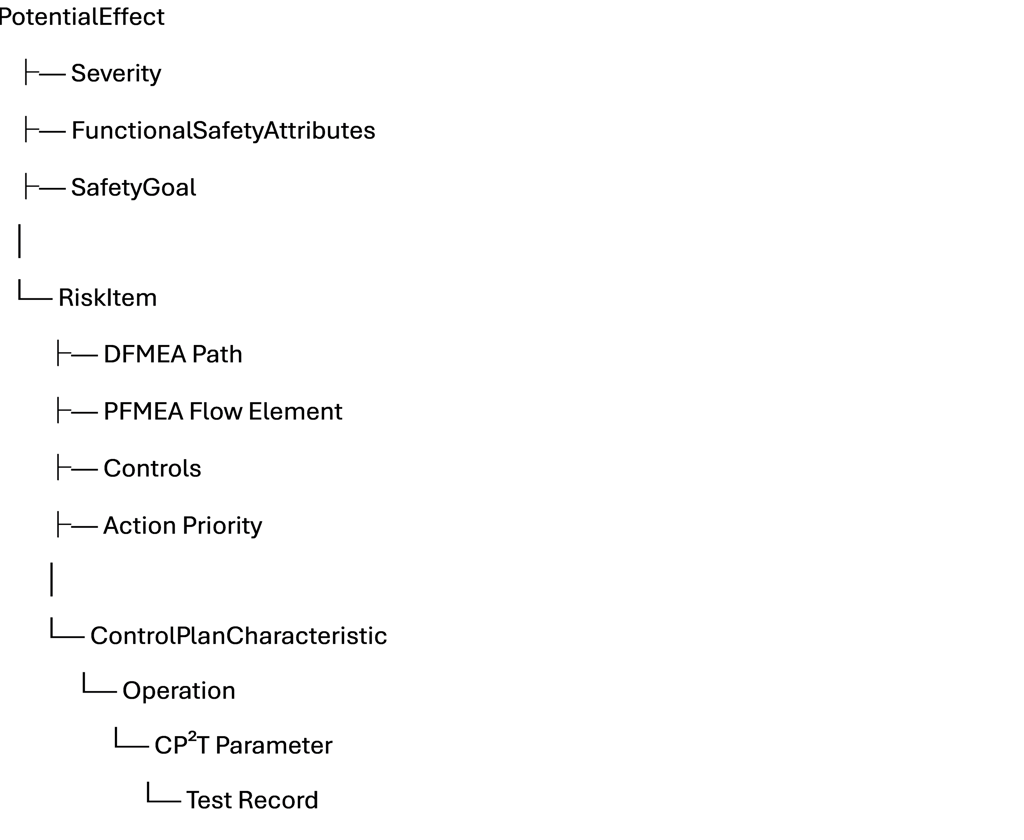
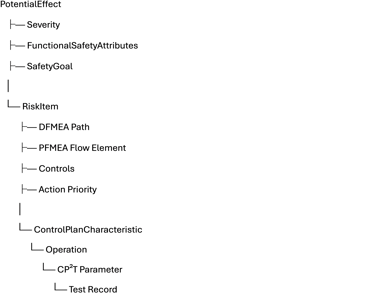
Conceptually, the architecture now resembles:
This creates a digital thread from:
Harm → Risk → Control → Process Step → Parameter → Measurement
Traceability is no longer a manual cross-reference exercise. It becomes a relational property.
6. CP²T and Operational Traceability
Extending the schema to operational control requires linking risk to measurable parameters.
The CP²T model supports:
CriticalParameter entity
OperationStepCriticalParameter linkage
Parameter thresholds
Reaction plans tied to parameter violations
When a CP²T parameter drifts out of tolerance, the system can identify:
Which Potential Effects are impacted
Which Functional Safety classifications apply
Which Action Priority is triggered
Which Safety Goals may be compromised
This is traceability in operational form.
7. AI Explainability Layer
The extended schema also enables AI-assisted risk intelligence.
By maintaining structured entities and relationships, the system supports:
Semantic tagging of risk logic
Knowledge graph identifiers
Embedding vectors for similarity clustering
Automated impact analysis across LifecycleTraceability links
AI can now reason across harm, design, manufacturing, and operational data without hallucinating connections.
Explainability is preserved because relationships are explicit.
8. Governance Choice: AP, Functional Safety, or Both
Not all organizations need the same safety architecture.
When AP Alone May Suffice
Moderate risk products
Organizations seeking stronger action governance
Environments where regulatory expectations focus on prioritization discipline
When Functional Safety Is Required
High criticality systems
Automotive, aerospace, and complex embedded systems
Products where integrity levels are mandated
When Combining Both Is Strongest
MedTech products with software-driven risk
Organizations seeking cross-industry harmonization
Enterprises building AI-assisted governance models
The schema does not force a doctrine.
It anchors severity at the effect level and allows layered governance logic.
Sidebar: Why Severity Must Live on the Effect
When severity is defined per row:
DFMEA and PFMEA disagree
AP results vary unpredictably
Functional Safety classifications fragment
When severity belongs to the Potential Effect:
Harm remains consistent
Governance logic stabilizes
Cross-product analytics becomes possible
This is the architectural pivot point of FMEA 4.0.
9. Conclusion
Extending the FMEA 4.0 schema to include Functional Safety, Action Priority, and full traceability transforms FMEA from a scoring worksheet into a unified risk intelligence backbone.
It becomes:
Severity-driven
Lifecycle-connected
Digitally traceable
Compatible with AP, Functional Safety, or hybrid governance
Future-ready for AI integration
Risk management stops being a document set.
It becomes an engineered system.
In the next article, we examine why AI requires this structured foundation and what happens when risk data is not built for reasoning.