
FMEA 4.0 Designing an AI-Ready FMEA Database Schema (ARTICLE 5)
From Flat Spreadsheets to Structured, Connected, Queryable Knowledge. What does an optimal FMEA database schema look like?
THE LEARNING LOOPINTELLIGENT MANUFACTURING TRANSFORMATIONRISK MANAGEMENT
Manfred Maiers
1/16/20269 min read


From Flat Spreadsheets to Structured, Connected, Queryable Knowledge
A modern FMEA system must be relational, normalized, graph-aware, and AI-ready.
If Article 1 explained why Excel breaks FMEA integrity, and Article 2 explained why databases solve it, Article 3 and 4 focused on new ways to organize FMEAs, this article answers the next critical question:
Why FMEA Must Evolve Now
For decades, DFMEA and PFMEA have been treated as parallel but separate exercises. One lived with design teams. The other lived on the manufacturing floor. Both usually lived in Excel.
That separation worked when products were simpler, data volumes were smaller, and risk management was largely a document-driven activity. It no longer works in a world of complex medical devices, software-driven behavior, global manufacturing, and increasing regulatory expectations for traceability, consistency, and post-market learning.
FMEA 4.0 is not about doing FMEA differently for the sake of novelty. It is about structuring risk in a way that reflects reality, supports lifecycle decision-making, and is fundamentally ready for AI-assisted reasoning.
Why Excel-Based FMEAs Structurally Fail Modern Risk Management
Excel is flexible, familiar, and dangerously misleading.
The core problem is not usability. It is structure.
Spreadsheet FMEAs force risk into rows that mix unrelated concepts:
Failure modes
Effects
Severity
Causes
Controls
Actions
This creates predictable failures:
Severity is duplicated and reinterpreted across DFMEA and PFMEA
The same patient harm is described differently in multiple places.
Design and manufacturing risks cannot be analyzed together.
Risk history cannot be queried, reused, or reasoned over.
AI sees noise, not structure.
No amount of formatting, macros, or templates fixes the underlying issue. The data model itself is wrong.
Re-Thinking DFMEA Organization
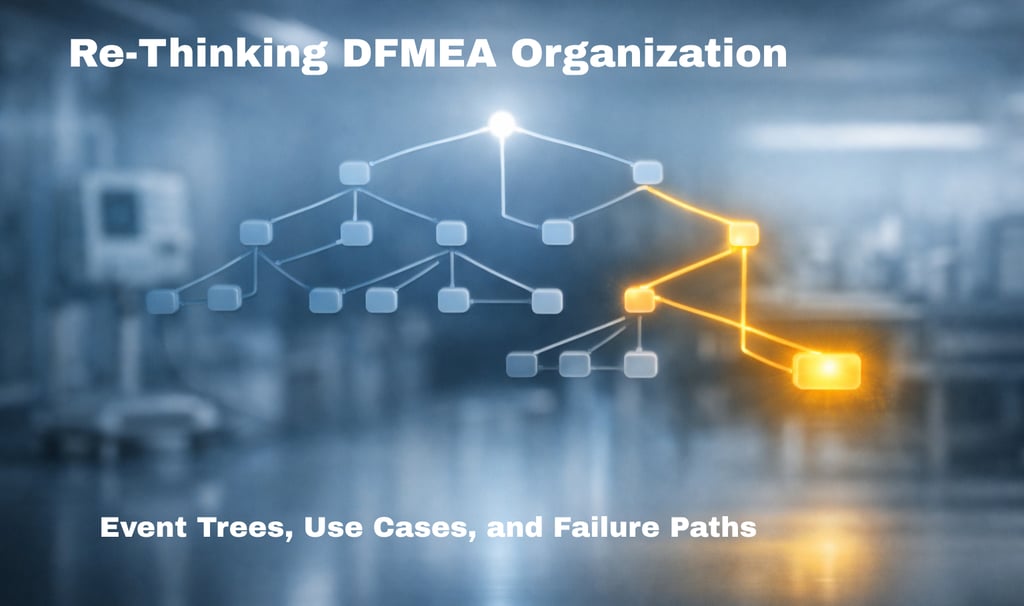
From Functions to Use Cases and Paths
Traditional DFMEA starts with functions and components. Regulators do not think this way. Neither do users.
FMEA 4.0 starts with Intended Use and Use Cases:
Who is the device for?
In what environment
Under what assumptions
In what scenarios
From each use case, DFMEA logic unfolds through event trees:
What happens next?
What decisions or conditions matter
How different paths lead to different outcomes.
Risk is no longer attached to a vague function. It is attached to a specific path that leads to a defined outcome.
This matters because:
Severity is tied to outcomes, not mechanisms.
Different paths with the same failure mode can have very different impacts.
Auditors can trace harm back through explicit logic, not implied reasoning.
Re-Thinking PFMEA Organization
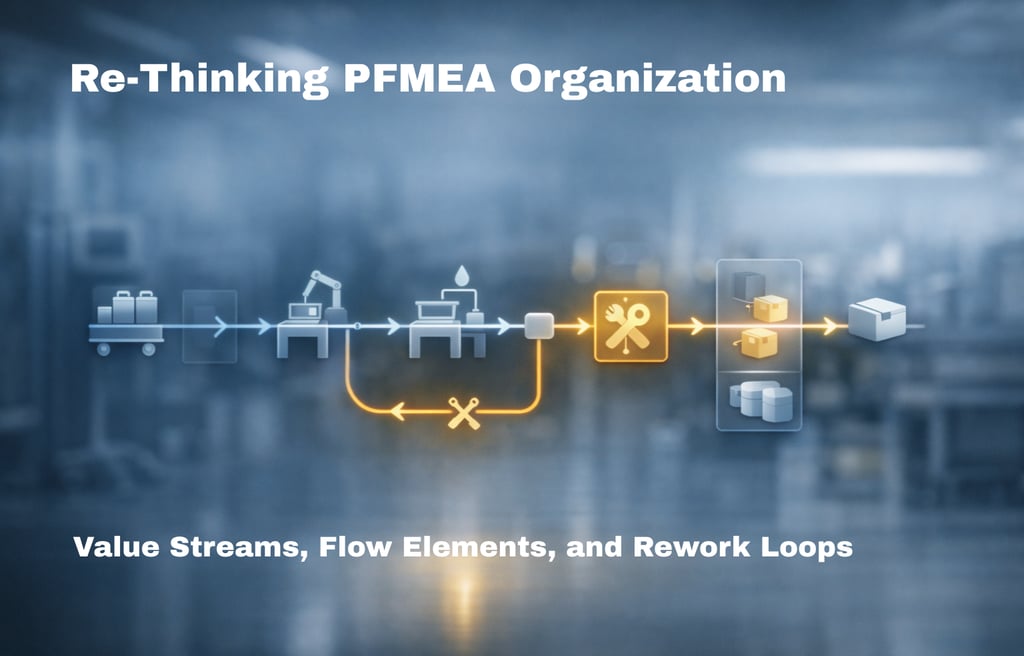
From Operation Lists to Value Streams and Flow
PFMEA has traditionally been organized as a list of operations. That hides how manufacturing actually works.
FMEA 4.0 organizes PFMEA around value streams:
End-to-end flow from incoming material to shipment
Real process routing, not idealized sequences
Within a value stream, risk is anchored to flow elements:
Process steps
Handoffs
Queues and WIP
Test and inspection gates.
Rework loops
This reveals risks that spreadsheets routinely hide:
Damage and mix-ups during handoffs.
Risk accumulation in queues.
False passes at test stations
Defects introduced during rework
PFMEA becomes a true model of manufacturing behavior, not just a compliance artifact.
DFMEA and PFMEA Are Not Separate Worlds


Why Potential Effects and Severity Must Be Shared
A patient does not care whether harm originated in design or manufacturing.
An overdose caused by:
a bolus algorithm defect, or
a mis-calibrated flow test
is still an overdose.
FMEA 4.0 introduces Potential Effects of Failure as first-class, reusable entities:
Canonical effect statements
Owned severity
Explicit clinical impact classification
Risk items, whether DFMEA or PFMEA, link to these effects instead of redefining them.
This eliminates:
Severity drift
Duplicate patient harm descriptions
Artificial DFMEA versus PFMEA boundaries
It also enables something Excel never can: true convergence analysis across lifecycle phases.
What a Database Schema Is and Why It Matters for FMEA 4.0
When people hear “database,” they often think about storage or IT infrastructure.
In reality, the most important part of a database is the schema.
A database schema is the formal definition of:
what information exists,
how it is structured,
and how different pieces of information are allowed to relate to each other.
In other words, a schema encodes rules of meaning, not just tables and columns.
Excel has no schema. Every row is free to redefine reality.
FMEA 4.0 is built on the idea that risk management needs structure that enforces intent.
One-to-Many Relationships Explained in Plain Language
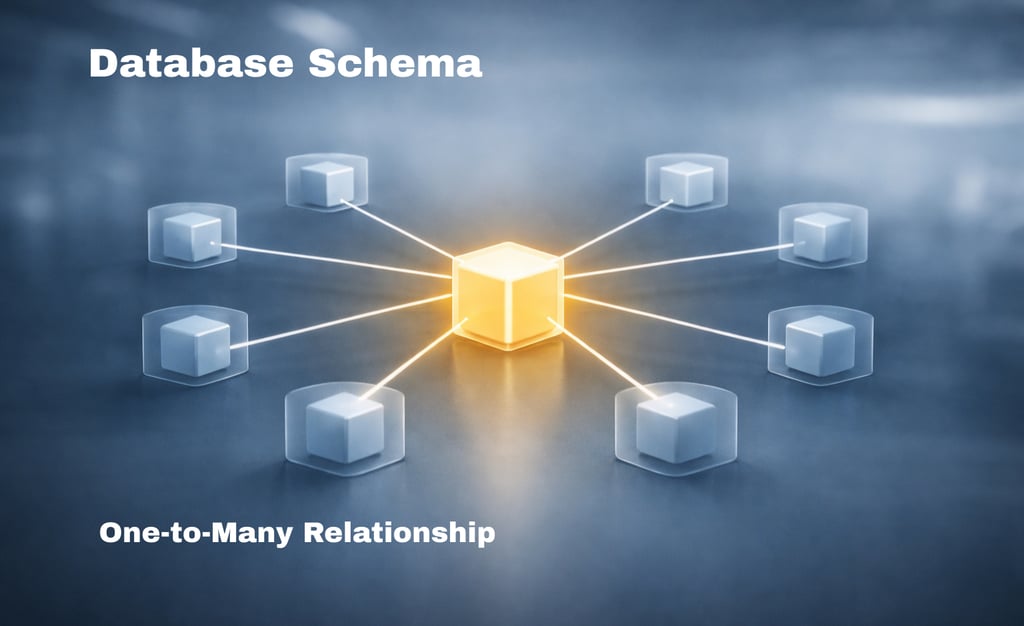
One of the most important concepts in a schema is a one-to-many relationship.
In simple terms:
One thing exists once.
Many other things can reference it.
For FMEA 4.0, the critical example is Potential Effects of Failure.
The problem Excel cannot solve.
In Excel-based FMEAs:
The same patient harm is written dozens of times.
Severity is reinterpreted by different teams.
DFMEA and PFMEA describe the same effect differently.
There is no reliable way to say, “these risks lead to the same harm.”
This is not a process problem.
It is a structural one.
How FMEA 4.0 Uses One-to-Many Relationships
In the FMEA 4.0 schema:
A Potential Effect of Failure exists once.
It owns:
the effect statement
the severity
the clinical impact classification
Many risk items can link to that same effect.
This is a classic one-to-many relationship:
One potential effect
Many DFMEA and PFMEA risks referencing it.
The risks do not redefine the effect.
They reference it.
This single design decision enforces consistency automatically.
Why This Changes Everything
Because severity belongs to the effect and not the risk row:
DFMEA and PFMEA cannot disagree on severity for the same harm.
Manufacturing escapes and design flaws converge naturally.
Patient impact becomes lifecycle-independent.
Analytics can group risks by actual outcomes, not wording.
It also enables reasoning that is impossible in spreadsheets:
“Show me all risks that could lead to over-delivery of medication.”
“Which manufacturing steps contribute to the highest patient severity?”
“Where do DFMEA and PFMEA converge on the same harm?”
Those questions are trivial in a schema-driven model and nearly impossible in Excel.
Why This Structure Is Inherently AI-Ready
AI systems rely on relationships, not prose.
When effects are shared through explicit one-to-many relationships:
AI can cluster risks by patient harm.
AI can detect systemic contributors across lifecycle phases.
AI can prioritize actions based on impact, not frequency.
Without a schema, AI only sees disconnected text.
With a schema, AI sees causal structure.
That is the difference between automating documentation and enabling intelligence.
The Hidden Benefit: Governance Without Policing
A schema does not rely on people remembering rules.
It enforces them.
Once Potential Effects of Failure are modeled as shared entities:
Duplication becomes impossible.
Severity drift is structurally prevented.
DFMEA and PFMEA alignment is automatic, not negotiated.
This is why FMEA 4.0 is not just “digital FMEA.”
It is designed risk governance.
One FMEA Database, Many Products, and Why That Matters


A critical shift introduced by FMEA 4.0 is that the database does not represent a single FMEA. It represents many FMEAs across many products, all governed by the same structure. Each product has its own intended uses, use cases, value streams, and risks, but they all live within a shared, consistent schema.
This is a fundamental departure from spreadsheet-based thinking. In Excel, each FMEA is a separate file. Knowledge is isolated by product, by team, and often by time. In an FMEA database, risk knowledge becomes cumulative and reusable. Design and manufacturing risks can be analyzed across product families, generations, sites, and processes without reinterpreting the data.
This is what enables organizations to answer questions that are otherwise unmanageable, such as finding patient harms that appear across multiple products, or manufacturing steps that repeatedly contribute to the same clinical risk.
Why SQL Matters for Risk Management at Scale
Structured Query Language, or SQL, is the standard language used to work with relational databases. Its purpose is simple but powerful: to extract facts.
In risk management, extracting facts means retrieving the specific, relevant information needed for analysis, reporting, audits, and decision-making. SQL is designed precisely for this task. It allows users to ask precise questions of large, structured datasets and receive consistent, traceable answers.
In the context of an FMEA database, SQL is not a technical detail. It is the mechanism that turns structured risk data into insight.
Joining Tables: Connecting Risk Across Products and Phases
In an FMEA 4.0 database, information is intentionally distributed across multiple tables. Products, risk items, potential effects, value streams, and use cases are all stored separately and linked through defined relationships.
SQL allows these tables to be joined together using common identifiers. A join enables the retrieval of related information that lives in different places, such as:
which PFMEA risks across all products link to the same patient harm
which DFMEA paths and manufacturing steps converge on the same potential effect
which products share common high-severity outcomes?
Because these relationships are explicit in the schema, SQL joins are reliable and repeatable. The same question asked today and six months from now yields the same answer, something Excel cannot guarantee.
Aggregating Data: Seeing Patterns, Not Rows
SQL also provides aggregation capabilities that allow users to move beyond individual risks and see patterns.
Aggregate functions such as:
COUNT
MAX
MIN
AVG
SUM
make it possible to summarize risk across products and lifecycle phases.
In practice, this enables questions like:
how many products share the same patient harm.
which potential effects have the highest severity across the portfolio?
where manufacturing risks accumulate most frequently
how many risks remain open by product, site, or severity level.
This type of aggregation is essential for management review, CAPA prioritization, and post-market surveillance. It is nearly impossible to do consistently when risk data is fragmented across spreadsheets.
Quality Practices Enabled by Structured Extraction
Because SQL operates on structured data, it supports quality practices that regulators expect but spreadsheets struggle to deliver:
consistent reporting across products
traceable audit responses
repeatable risk reviews
defensible management summaries
Most importantly, SQL does not change the data. It only reveals what is already there. When the schema is well designed, extracting facts becomes safe, predictable, and auditable.
This is why an FMEA database is not just a storage solution. It is an analytical foundation that allows organizations to manage risk as a system rather than as isolated documents.
Example SQL Queries (Infusion Pump)
These should appear as callout boxes titled
“What an FMEA 4.0 Database Lets You Ask Instantly”
“Show all risks that could lead to over-delivery of medication”


Why this matters:
This returns both DFMEA and PFMEA risks that converge on the same patient harm, without manual cross-referencing.
“Which lifecycle phase contributes most to patient overdose risk?”


Why this matters:
You can quantify whether overdose risk is driven more by design logic or manufacturing escapes, instead of debating opinions.
“Why does this PFMEA test escape have the same severity as a DFMEA bolus failure?”
(SQL not shown)
Why this matters:
Severity is owned by the effect, not negotiated by the team that discovered the failure.
Value Stream Intelligence Enabled by Explicit Routing
This section pairs perfectly with the PFMEA value-stream graphic.
“Show me all ways a unit can reach rework”
(SQL not shown)
“Which test gates cause the most rework routing?”
(SQL not shown)
Why these matters
This enables loop-aware PFMEA reasoning:
Rework is not a footnote
It is a measurable risk amplifier
And it often correlates with patient-critical effects
Manufacturing Lens: What Operations Actually Use
This section supports the manufacturing risk lens narrative.
“What drives scrap, rework, delays, and cost of quality?”
(SQL not shown)
“Which PFMEA risks never reach the patient but still matter?”
(SQL not shown)
Why this matters:
This is day-to-day operational intelligence for manufacturing engineering, QA, and ops leadership.
What Makes an FMEA “AI-Ready”
AI does not need more data. It needs better structure.
An AI-ready FMEA has:
Explicit relationships instead of free text
Stable identifiers instead of copied phrases
Clear separation of causes, effects, and outcomes
Reusable risk knowledge across products and sites
With FMEA 4.0, AI can:
Cluster risks by shared patient harm!
Detect manufacturing contributors to clinical risk.
Find systemic weaknesses across value streams.
Prioritize actions based on real impact, not row counts.
None of this is feasible with spreadsheets.
Dual Risk Lenses
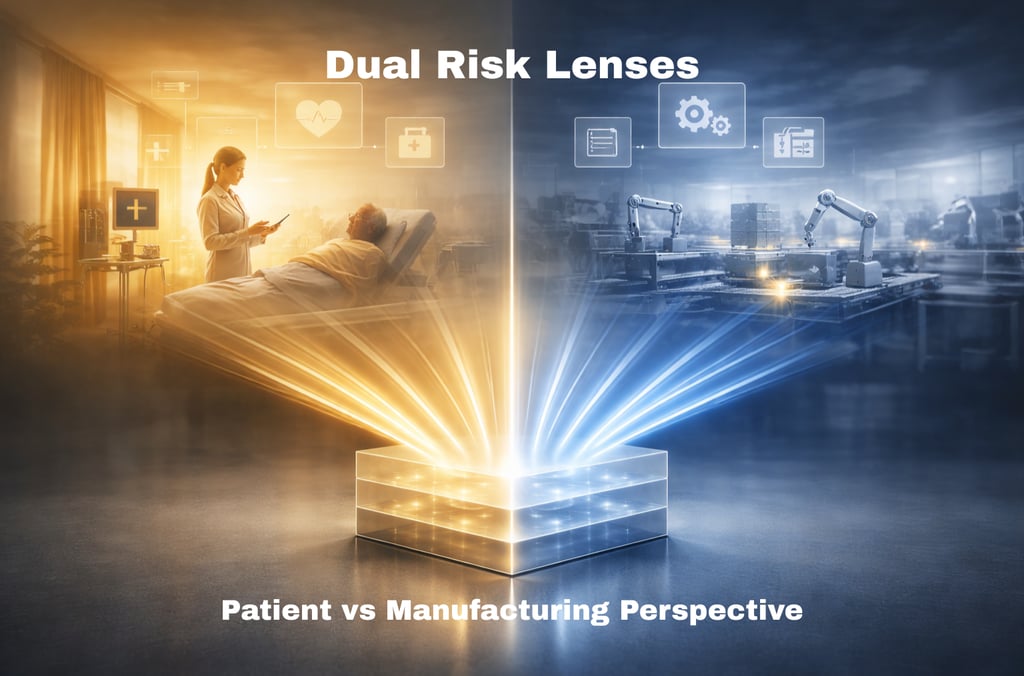
Patient and Manufacturing Perspectives
FMEA 4.0 supports two simultaneous lenses without duplicating work.
Patient Risk Lens
Includes any risk linked to clinically impactful effects.
Used for ISO 14971, safety committees, and regulatory review.
Aggregates DFMEA and PFMEA transparently
Manufacturing and Compliance Lens
Includes non-clinical effects like rework, scrap, release delays.
Used for operational excellence and cost of quality.
Remains connected to patient risk where relevant.
This allows organizations to manage what matters without losing sight of safety.
Supporting Audits, CAPA, and Post-Market Learning
Because FMEA 4.0 is structured:
Audit questions are answered with queries, not meetings.
CAPAs link back to explicit paths and flow elements
Complaints and post-market signals can be mapped to existing risk logic.
Risk management becomes a living system, not a static deliverable.
Why This Transformation Requires More Than Software
FMEA 4.0 is not a tool you install. It is a capability you build.
It requires:
Deep understanding of regulated risk management
Practical manufacturing and design experience
Careful migration from legacy Excel data
Governance that keeps the model clean over time
This is where most organizations struggle.
Why NoioMed
NoioMed does not simply convert spreadsheets into databases.
We work with organizations to:
Redesign DFMEA and PFMEA thinking.
Build AI-ready, regulator-credible risk architectures.
Migrate legacy Excel FMEAs without losing intent.
Enable real lifecycle risk intelligence.
If your FMEAs live in spreadsheets today, they are holding your organization back. Not because your people are failing, but because the structure is.
FMEA 4.0 is how risk management becomes an asset instead of an obligation.
Visit the NoioMed website to learn how we help organizations transform Excel-based FMEAs into scalable, AI-ready FMEA 4.0 systems.