
DFMEA and PFMEA Are Not Separate Worlds
Why Potential Effects of Failure and Severity Must Be Shared
THE LEARNING LOOPRISK MANAGEMENT
Manfred Maiers
1/22/20263 min read
Design FMEA and Process FMEA are often treated as separate artifacts. Different owners. Different spreadsheets. Different review meetings.
Yet from a risk management and regulatory standpoint, DFMEA and PFMEA are tightly connected. One of the most important and most misunderstood areas of overlap is Potential Effects of Failure and the associated Severity (S) rating.
If this connection is not managed deliberately, inconsistencies creep in, audits get uncomfortable, and risk decisions lose credibility.
Potential Effects of Failure Are About Impact, Not Origin
In both DFMEA and PFMEA, the Potential Effect of Failure answers the same fundamental question:
What happens to the system, the patient, or the end user if this failure occurs?
The key point is this:
The effect describes the outcome, not where the failure originated.
In DFMEA, the failure mode originates from the design.
In PFMEA, the failure mode originates from the manufacturing or assembly process.
But when the result is the same, the potential effect is the same.
And when the potential effect is the same, the Severity rating must be the same.
Severity Belongs to the Effect, Not the Failure Mode
Severity is often misunderstood as a property of a failure mode. It is not.
Severity is a property of the effect of that failure.
This means:
Different failure modes can exist.
Different causes can exist.
Different controls can exist.
Yet the Severity must remain identical if the impact to the user or patient is identical.
Changing Severity because the failure came from design versus process is not risk based reasoning. It is a data management problem disguised as judgment.
A Practical MedTech Example: Infusion Pump
Consider an infusion pump.
Shared Potential Effect of Failure
Over-delivery of drugs
This effect can arise from quite various sources.
DFMEA Perspective
Potential design failure mode:
Incorrect flow rate algorithm
Sensor selection error
Effect:
Over-delivery of drugs
Severity:
High, based on patient harm
PFMEA Perspective
Potential process failure mode:
Calibration error during manufacturing
Assembly tolerance stack-up
Effect:
Over-delivery of drugs
Severity:
Must be the same high severity.
The failure modes are different.
The causes are different.
The controls are different.
The effect and Severity are identical.
The Overlap Between DFMEA and PFMEA
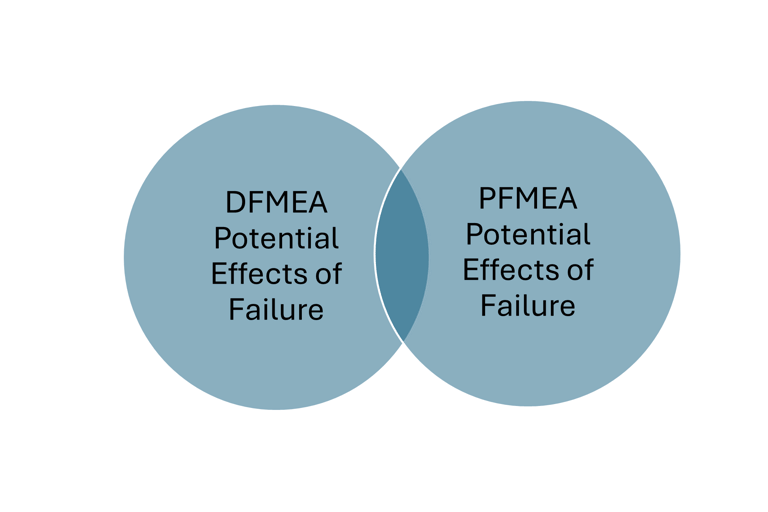
Conceptually, this relationship can be visualized as a Venn diagram:
Left circle: DFMEA Potential Effects of Failure
Right circle: PFMEA Potential Effects of Failure
Overlapping area:
Effects that apply to both design and process failures
“Over-delivery of drugs” sits squarely in that overlap.
This overlap is not an exception. In most complex medical devices, it is the rule.
Why Excel Makes This So Hard to Get Right
In Excel-based FMEA systems:
DFMEA and PFMEA live in separate files.
Potential Effects of Failure are copied and pasted.
Severity values are manually re-entered.
Updates happen in one place but not the other.
Over time, this leads to:
Severity drift
Duplicate effects with different wording
Justifications that no longer align.
Audit findings that are hard to defend
None of this is a failure of engineering intent. It is a limitation of the tool.
Why a Database-Driven FMEA Changes Everything
A relational FMEA database introduces a fundamentally different structure.
Potential Effects of Failure exist as their own table.
Each effect has one authoritative Severity rating.
DFMEA and PFMEA reference the same effect record.
Changes propagate automatically and consistently.
This structure:
Enforces Severity consistency by design.
Improves traceability across lifecycle phases.
Supports regulatory defensibility.
Enables analytics and AI readiness later.
Most importantly, it aligns the data model with how risk works.
The Takeaway
If you remember only one thing:
Severity belongs to the effect, not the failure mode.
When DFMEA and PFMEA reference the same potential effect, they must share the same Severity rating.
Excel makes this difficult.
Databases make it natural.
This is not just a tooling upgrade. It is a risk management maturity step and a foundational principle of FMEA 4.0.